
Home
Blog
Overview of all products
SalesData
LibraryData
CataList
Loan Stars
BiblioShare
Webform
EDI
Products for publishers
Products for retailers
Products for libraries
Information for authors
BNC Research
Canadian literary awards
SalesData & LibraryData Research Portal
Events
Tech Forum
Webinars & Training
Code of Conduct
Standards
EDI standards
Product identifiers
Classification schemes
ONIX standards
About
Contact us
Media
Bestseller lists
Newsletters
Podcast
Jobs
SalesData
LibraryData
CataList
BiblioShare
Webform
EDI

BookNet Canada

Home
Blog
Overview of all products
SalesData
LibraryData
CataList
Loan Stars
BiblioShare
Webform
EDI
Products for publishers
Products for retailers
Products for libraries
Information for authors
BNC Research
Canadian literary awards
SalesData & LibraryData Research Portal
Events
Tech Forum
Webinars & Training
Code of Conduct
Standards
EDI standards
Product identifiers
Classification schemes
ONIX standards
About
Contact us
Media
Bestseller lists
Newsletters
Podcast
Jobs
SalesData
LibraryData
CataList
BiblioShare
Webform
EDI
BookNet Canada
June 1, 2026
ONIX, Standards & Metadata

Strategies for streamlining ONIX creation

BookNet Canada
June 1, 2026
ONIX, Standards & Metadata

Metadata drives discovery, sales, and supply chain efficiency. In the Canadian market, where publishers, distributors, and retailers rely heavily on standardized communication, high-quality metadata is not optional. It is foundational.

This blog post outlines strategies for streamlining ONIX creation, maintenance, and distribution.

The Canadian book industry has largely moved to ONIX 3, the latest standard for sharing book metadata. It’s no secret that it can feel complex and overwhelming to work with XML files. To make things easier, most publishers rely on specialized tools or cloud-based systems that simplify the process. These platforms help with everything from entering and validating metadata to distributing it efficiently to retailers and partners. Across Canada, publishers and distributors are using a range of solutions designed to take the hassle out of ONIX while keeping their data accurate and up to date.

What to look for in an ONIX tool

No matter which platform you choose, the most effective ONIX tools tend to have a core set of features that follow ONIX 3 best practices and make day-to-day work easier for publishing teams.

At a minimum, your ONIX system should serve as a single source of truth for all your title metadata. That means one central place where your team can create, update, and manage information about your books. Everything from ISBNs and pricing to contributors, formats, and marketing copy. When your metadata lives in one reliable system, it reduces errors, avoids duplication, and ensures that everyone in your internal staff, retailers, and distributors are working with accurate, up-to-date metadata.

Strong ONIX tools also help simplify complex workflows. Look for features like: guided data entry, built-in validation to catch errors before files are sent out, and easy distribution to trading partners. In the Canadian market, where publishers often work with multiple retailers and distributors, or may have bilingual metadata requirements, having a tool that keeps everything organized and consistent can make a big difference.

In short, the right ONIX system should take something that’s technically complex and make it manageable, so your team can focus less on formatting data and more on getting great books into readers’ hands.

A good ONIX tool should have the following:

1. Structured metadata entry

The system should guide users to input data in a way that maps directly to the latest ONIX schema and codelists.

2. Validation and quality control

Look for built-in validation against ONIX standards and trading partner requirements. This reduces errors before distribution.

3. Automation (for large publishers)

Automated feed generation and delivery are essential. Manual exports increase the risk of outdated or inconsistent data.

4. Versioning and updates (for larger publishers)

The ability to track changes and send incremental updates aligns with ONIX 3’s block update model.

5. ONIX distribution to multiple trading partners

Your tool should support distribution to different trading partners via FTP. Or it should allow an easy download of an ONIX file with your desired list of ISBNs and date range. This way you can use FileZilla or similar software to send your ONIX data to aggregators like BiblioShare.

6. Ability to grow your catalogue

As your catalogue grows, the system should allow you to add more titles/records, and allow you to enter all fields available in the current version of ONIX 3.

Examples of such systems are BiblioShare Webform, geared toward small and medium sized publishers. There is also ONIXEdit, BooksONIX, and other similar systems for medium to large publishers and distributors.

At the core these systems are similar, they all create ONIX files and are able to send data via FTP. Some platforms offer additional features to meet publisher and distributor needs.

For more information on how these systems might work, read our blog post about data handling through Biblioshare Webform.

Choosing the right tool for your organization

The right choice depends on your size, complexity, and distribution needs. There is no single best tool.

  • Small publishers may start with lightweight or cloud-based tools that simplify ONIX creation, maintenance, and FTP distribution.

  • Mid-sized publishers often benefit from integrated title management systems with ONIX export capabilities, a bulk-edit function, and FTP transfer to multiple trading partners.

  • Large publishers and distributors typically require advanced ONIX platforms with basic cataloguing and validation features, and FTP transfer to multiple trading partners. Additionally, some may require automation features for catalogue update and ONIX distribution.

Metadata entry: Getting it right from the start

When it comes to ONIX, nothing is more critical than getting metadata right from the start.

ONIX 3 organizes product records into functional blocks.

  • DescriptiveDetail

  • CollateralDetail

  • ContentDetail

  • PublishingDetail

  • RelatedMaterial

  • ProductSupply

  • PromotionDetail

  • ProductionDetail

In most ONIX creation and maintenance systems, these data blocks are laid out in a way that’s much easier to navigate than the raw ONIX format. Instead of dealing with a long, complex file, you’ll typically see the information grouped into clear sections or tabs in a cloud-based catalogue or software hosted on your computer.

For example, in BiblioShare’s Webform, ONIX blocks are organized as their own tabs. This means you can simply click into the section you need whether it’s descriptive details, pricing, or contributor information, and start entering or updating data right away. This kind of layout helps reduce confusion, keeps your workflow organized, and makes it easier for teams to manage metadata accurately without needing deep technical knowledge of ONIX itself.

Supporting materials — covers, interiors, samples

A good ONIX management system should also make it easy to handle all your supporting media, not just metadata. That includes uploading, organizing, and distributing cover images, interior PDFs, spread samples, and other file types supported in ONIX 3. Instead of juggling files across different platforms, your team should be able to manage everything in one place, link assets directly to the correct titles, and ensure they’re delivered to retailers and partners alongside your metadata. This helps keep your book listings complete, professional, and consistent across the supply chain.
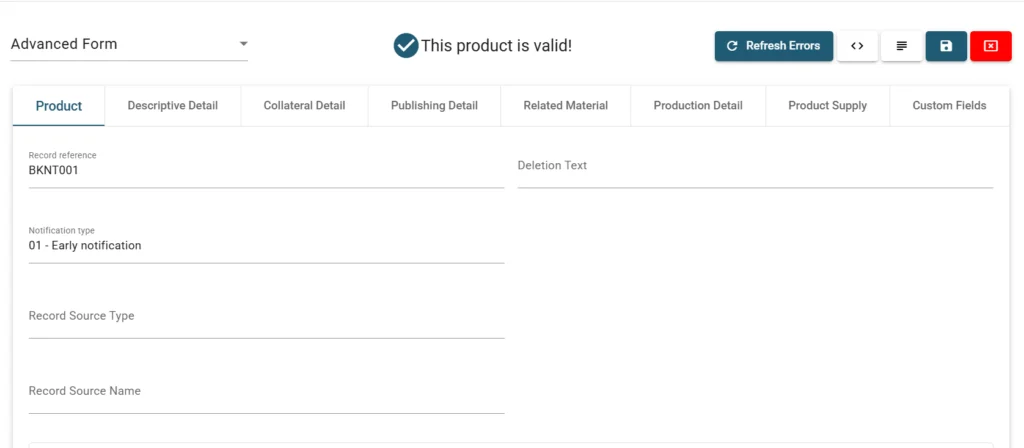
BiblioShare Webform - Advanced Form view

Approach to data entry

When working with ONIX, it’s best to include as much accurate, relevant information as you can. The more complete your metadata, the more useful it is to retailers, distributors, and readers. If you’re unsure about a field, resources from EDItEUR or our collection of blog posts about ONIX can help guide you.

Be sure to fill in key details about your publisher, imprint, contributors, and production. These are essential for clearly identifying and positioning your title in the market.

Include subject codes using both BISAC and Thema to improve discoverability across different systems. You can browse our blog posts on Thema and standards for support. If you’re not sure where to start, read our most recent blog post: Thema: The missing half to your subject classification strategy.

Add identifiers wherever possible, such as ISNIs (International Standard Name Identifier). The use of ISNI is growing globally and can help uniquely identify contributors.

Don’t forget to include market, sales, and territory information. This is especially important for partners who are looking to distribute or sell your books in specific regions.

Make sure your publication date is accurate and formatted correctly, as it plays a key role in how your book is listed and promoted.

Finally, always include audience information for children’s and young adult titles to ensure they’re categorized and marketed appropriately.

Data distribution

ONIX files (in .xml format) are typically shared with partners using FTP, which allows publishers and distributors to send metadata in a consistent and reliable way.

A common approach is to send a full file every two to three months. This is a complete snapshot of your entire catalogue. In between those updates, you can send delta files on a weekly basis, which include only the titles that have changed since your last update. This keeps your metadata current without needing to resend everything each time.

For larger publishers, it’s worth looking for systems that support automated distribution. These tools can automatically send out updates whenever records change, saving time and helping ensure that partners always have the most up-to-date information.

Canadian market

While ONIX is a global standard, the Canadian market has specific requirements and practices. BookNet Canada provides localized guidance that reflects relationships with Canadian retailers, libraries, and distributors.

  • Follow Canadian best practices alongside global standards

  • Ensure bilingual metadata where required

  • Consider regional subject classifications and audience needs

  • Enter rich, accurate metadata from the start

  • Store it in a centralized, structured system

  • Share metadata updates with your trading partners

The strongest metadata operations combine systems that align organizational needs with structured, well-documented workflows.

In Canadian publishing, landscape standards and collaboration are deeply embedded. Investing in the right tools is not just a technical decision, it is a strategic one that directly supports discoverability, sales, and long-term success.

To stay up to date on all that’s going on in the realm of standards and metadata, sign up for our newsletters!


Subscribe

Don’t miss any new blog posts. Sign up for our weekly eNews to receive updates.

You can unsubscribe at any time. We respect your privacy.

Thank you!
Recent posts
Strategies for streamlining ONIX creation

This blog post outlines strategies for streamlining ONIX creation, maintenance, and distribution.

Read more →
Podcast: The Heated Rivalry ripple effect impacting playwrights publishing in Canada

Annie Gibson talks to us about an unexpected entanglement between Heated Rivalry breakout star Hudson Williams and Playwrights Canada Press’ Yaga.

Read more →
Canadians and rising book prices 2025

How much are Canadian book buyers willing to pay for books, how Canadian book buyers are spending their money, and the value they attribute to books.

Read more →
Understanding Multi-item vs. Multicomponent products in ONIX:  Making sense of one of ONIX's trickiest distinctions
Understanding Multi-item vs. Multicomponent products in ONIX: Making sense of one of ONIX's trickiest distinctions

This new Application Note tackles what Executive Director Graham Bell calls "one of the trickier aspects of ONIX".

Read more →
Canadian book borrowers in 2025

Insights into the behaviour of Canadian book borrowers.

Read more →
May 2026 Loan Stars Junior Canadian top picks

Top Canadian Jr. picks for May 2026.

Read more →
Loan Stars is 10!
Loan Stars is 10!

Celebrate 10 years of Loan Stars and get a glimpse of the key numbers to note from the 177 top 10 lists we’ve shared!

Read more →
Canadian book buyers in 2025

Insights into the behaviour of Canadian book buyers.

Read more →
Subject Spotlight: Juvenile Fiction

Sales and library circulation data of Juvenile Fiction titles during the the first quarter of 2026.

Read more →
Canadians and their leisure time in 2025: Leisure & Reading study

This free report looks at how Canadians are spending their leisure time and the behaviours of Canadian readers in 2025.

Read more →
Easier with BookNet: Share notes with contact lists and groups in CataList

The Notes feature can be used to save notes privately or share them with your team or clients of your choice. Learn more about how else you can use Notes!

Read more →
Podcast: A peek into Canadians' reading

Listen in as we give you some of the highlights from our forthcoming report, Canadian Leisure & Reading Study 2025.

Read more →
Results from the AI use across the North American book industry survey

This report shares insights into the adoption of AI, applications of the technology, perception of value, interest in training, areas of concern, and more.

Read more →
Thema: The missing half to your subject classification strategy

Why and how should you use Thema? Here’s a series of resources that will help you understand its capabilities and help you get started in implementing it!

Read more →
The nuances of online book marketing in 2026

Ariel Hudnall, managing director of Serif, shares key insights into developing digital marketing strategies for the publishing industry.

Read more →
Canadian Independent Bookstore Day 2026

Celebrate Canadian independent bookstores on April 25!

Read more →
ONIX Codelist 73 released

Insights into the latest updates and additions made to ONIX codelists.

Read more →
Must-watch, must-read: The Oscars 2026 effect

How did being nominated for the Oscars in 2026 impact book sales, loans and holds among Canadians?

Read more →
5 key takeaways from trendspotting

What’s been trending in the Canadian publishing industry?

Read more →
Highlights from The Canadian Book Market 2025

Want to make data-informed decisions? We can help.

Read more →
EDItEUR releases latest ONIX 3.1 revision 3

EDItEUR announces publication of ONIX 3.1 revision 3.

Read more →
Podcast: The importance of social media in the publishing industry

Founder of Tandem Collective, Naomi Bacon, talks to us about how social media can be used to market books.

Read more →
How are Canadian readers celebrating neurodiversity?

How are neurodiversity-related titles performing in the Canadian book market?

Read more →
Sustainability at BookNet: 2025

BookNet’s 2025 greenhouse gas (GHG) emissions.

Read more →
Subject spotlight: Women

Sales and library circulation data of Women Fiction and Non-Fiction titles during the the fourth quarter of 2025.

Read more →
March 2026 Loan Stars Adult Canadian top picks

Find out which titles made it to the March 2026 Loan Stars Adult Canadian list.

Read more →
Leveraging standards in the wake of the big boom in romance

As romance takes the book world by storm yet again, we share insights regarding the impact this growth has had on existing standards.

Read more →
Revisiting the popularity of bread cookbooks

As we hit the six-year mark since the beginning of the pandemic, we’re revisiting cookbooks and bread-related cookbooks too, to check on how they’re doing.

Read more →
Smuggling green and inclusive tech past the gatekeepers

James Christie on today’s business climate and its effects on the implementation of sustainable, inclusive practices.

Read more →
Podcast: Breaking into the publishing industry with Vanessa Gomez

An interview with Vanessa Gomez about the online platform she created where new professionals can find relevant information about the industry.

Read more →

Tagged: onix 3.0, book metadata best practices

Older PostPodcast: The Heated Rivalry ripple effect impacting playwrights publishing in Canada
No results found
Blog RSS

The Canadian Book Market 2025 is the comprehensive guide to the Canadian market with in-depth category data.

Get your copy now

Listen to our latest podcast episode


  • Research & Analysis 480
  • Ebooks 304
  • Tech Forum 278
  • Conferences & Events 262
  • Standards & Metadata 251
  • Bookselling 221
  • Publishing 200
  • ONIX 195
  • Marketing 153
  • Podcasts 128
  • ebookcraft 112
  • BookNet News 106
  • Loan Stars 78
  • Libraries 67
  • BiblioShare 59
  • 5 Questions With 53
  • SalesData 51
  • Thema 47
  • CataList 44
  • Awards 30
  • Diversity & Inclusion 21
  • Sustainability 19
  • Publishing & COVID-19 18
  • EU Regulations 16
  • LibraryData 10
  • ISNI 4


BookNet Canada is a non-profit organization that develops technology, standards, and education to serve the Canadian book industry. Founded in 2002 to address systemic challenges in the industry, BookNet Canada supports publishing companies, booksellers, wholesalers, distributors, sales agents, industry associations, literary agents, media, and libraries across the country.


Privacy Policy | Accessibility Policy | About Us

BOOKNET CANADA

Contact us | (416) 362-5057 or toll free 1 (877) 770-5261

We acknowledge the financial support of the Government of Canada through the Canada Book Fund (CBF) for this project.

Back to Top

BookNet Canada acknowledges that its operations are remote and our colleagues contribute their work from the traditional territories of the Mississaugas of the Credit First Nation, the Anishnawbe, the Haudenosaunee, the Wyandot, the Mi’kmaq, the Ojibwa of Fort William First Nation, the Three Fires Confederacy of First Nations (which includes the Ojibwa, the Odawa, and the Potawatomie), and the Métis, the original nations and peoples of the lands we now call Beeton, Brampton, Guelph, Halifax, Thunder Bay, Toronto, Vaughan, and Windsor. We endorse the Calls to Action from the Truth and Reconciliation Commission of Canada (PDF) and support an ongoing shift from gatekeeping to spacemaking in the book industry.