

We’re back with more data from our annual Canadian Book Consumer survey! Last time, we dove into the book buying habits of Canadians in 2025. Today, we’re taking a look at Canadian book borrowers.
The Canadian Book Consumer survey has been active since 2012, and is our annual survey of Canadians and Canadian book consumers. In it, we survey Canadians quarterly about book buying, borrowing, and other book-related behaviours. In 2025, we surveyed 1,979 Canadians, 24% of whom borrowed a book from a public library.
Here’s what we learned about Canadian book borrowers in 2025.
In person visits to libraries by Canadian book borrowers remained high
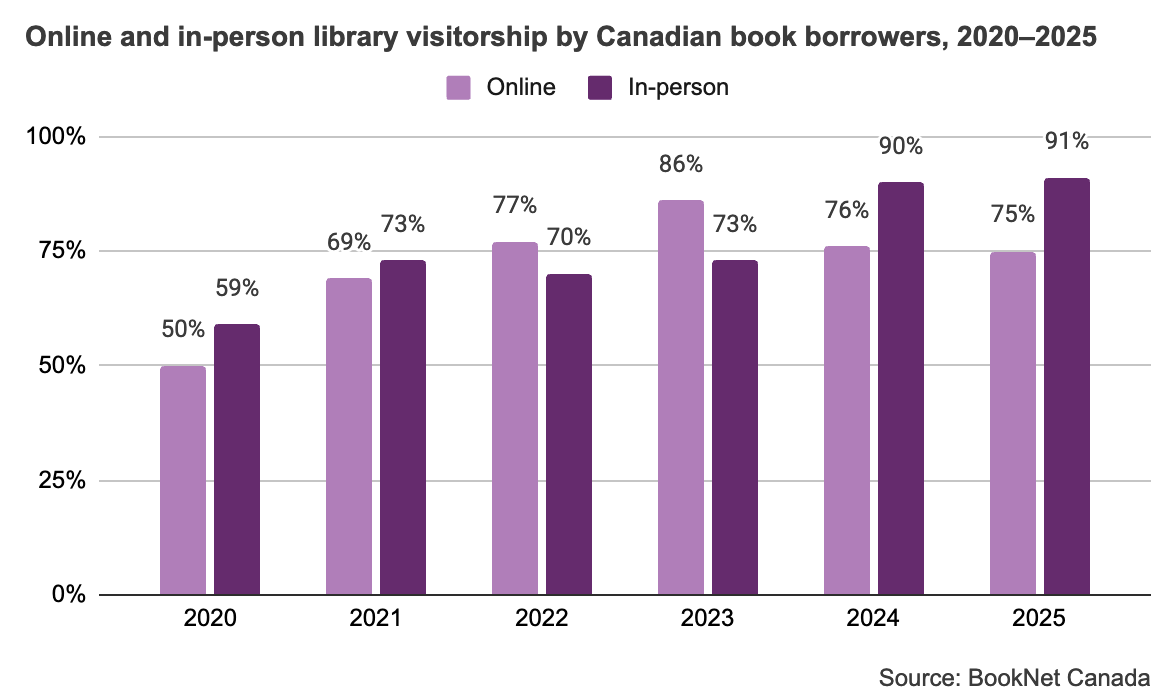
Since 2020, the percentage of Canadian book borrowers who visited the library at least once a month, either in person or online, has generally increased from 54% in 2020 to 83% in 2025. As we can see in the graph below, the share of online visitors has plateaued in 2025 and had slightly decreased from the high in 2023 (86%). The percentage of book borrowers who visited the library in-person also plateaued in 2025, but remains quite high at 91%.
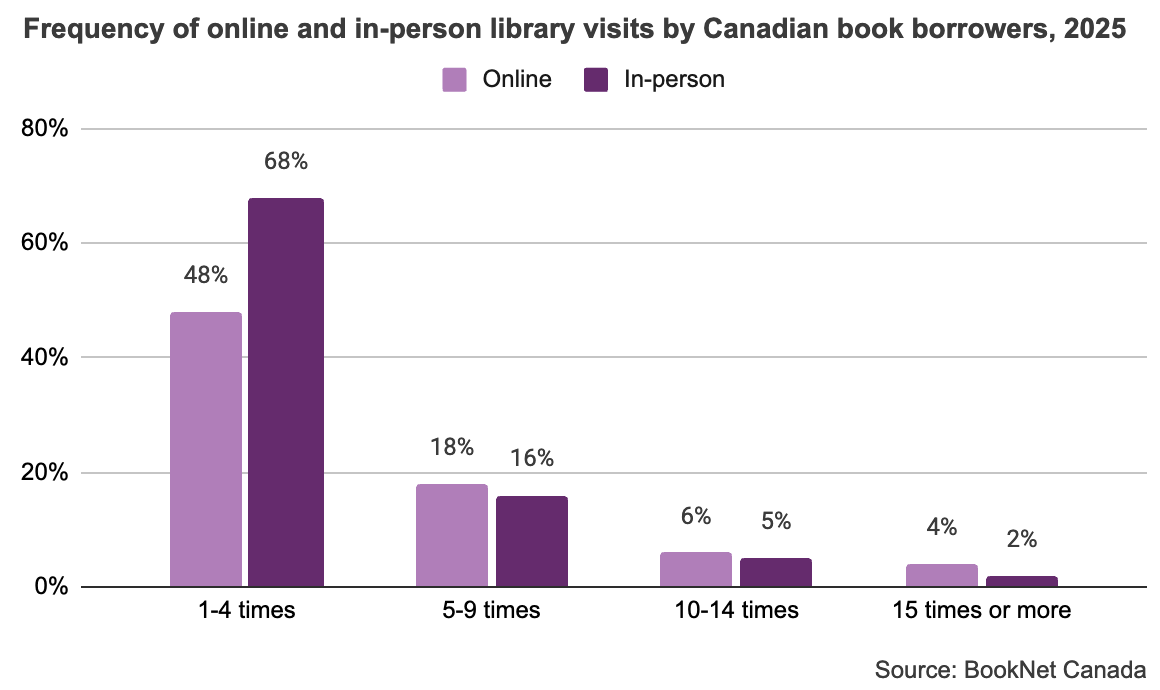
The graph below shows the frequency of these monthly library visits in 2025. Most Canadian book borrowers visit the library one to four times a month — 48% of book borrowers visited online and 68% visited in-person.
The most popular reasons for Canadian library book borrowers to visit the library in 2025 were:
To pick up hold(s) — 49%
To browse displays and shelves for books to borrow — 38%
To discover a new book, author, and/or illustrator — 24%
To put books/materials on hold — 21%
Picking up and putting materials on hold both increased in popularity for reasons to visit the library in 2025. “To pick up holds” increased from 39% in 2024 to 49% in 2025, and “To put books/materials on hold” increased from 16% in 2024 to 21% in 2025.
Print books were the most popular format to borrow
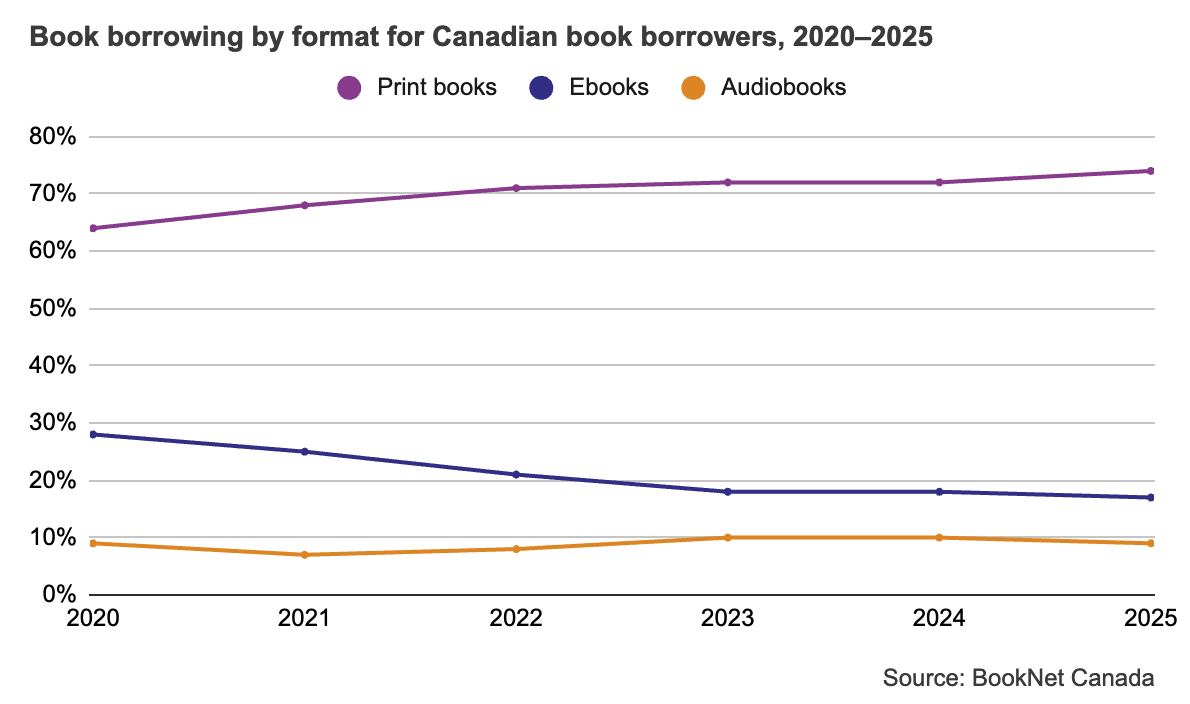
Overall, 74% of all books borrowed by Canadians in 2025 were print books, 17% were ebooks, and 9% were audiobooks, shown in the graph below. On average, Canadian library book borrowers borrowed 4.9 books a month in 2025 — 3.6 print books, 0.8 ebooks, and 0.4 audiobooks. This is very similar to 2024.
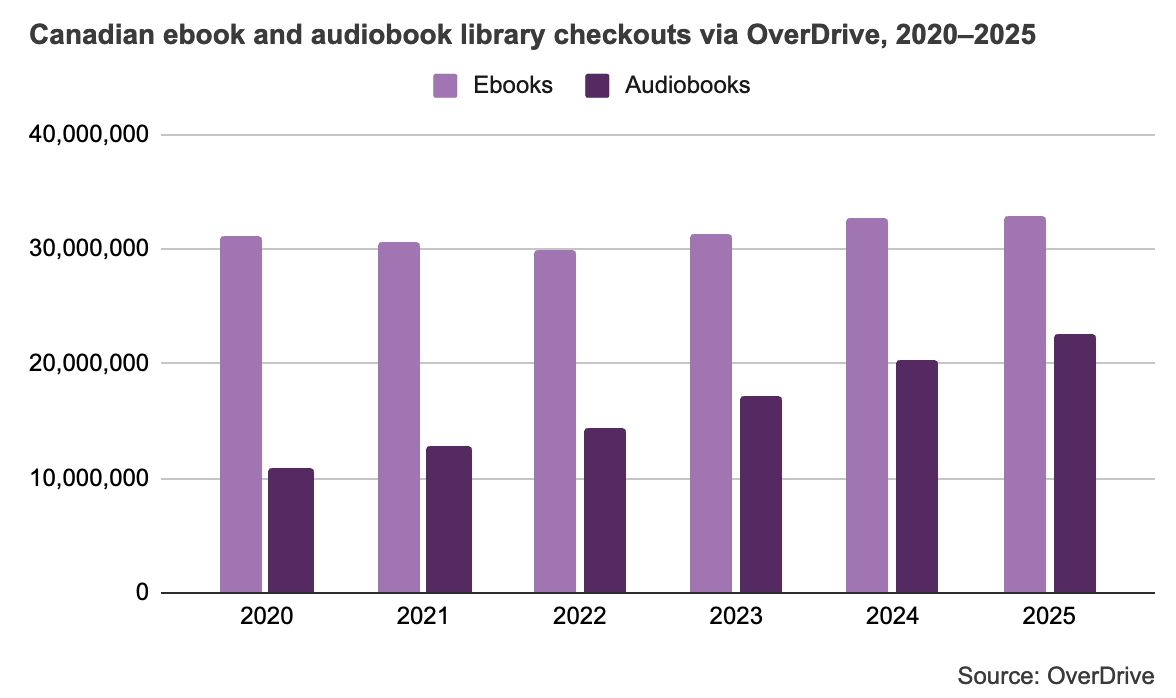
Data provided by OverDrive, the world’s leading digital reading platform for libraries and schools, offers more insight into the library circulation of digital ebooks and audiobooks in Canada. When we look at their data we can see the growth in ebook checkouts seems to have plateaued, but audiobook checkouts continue to increase year over year, a percent change of 11% between 2024 and 2025. In 2025, 59% of all digital library checkouts were ebooks, while 41% were audiobooks.
Altogether, 71% of book borrowers chose print books as their preferred book format, while 17% preferred ebooks, 8% preferred audiobooks, and 3% had no format preference. This is a very similar distribution to 2024.
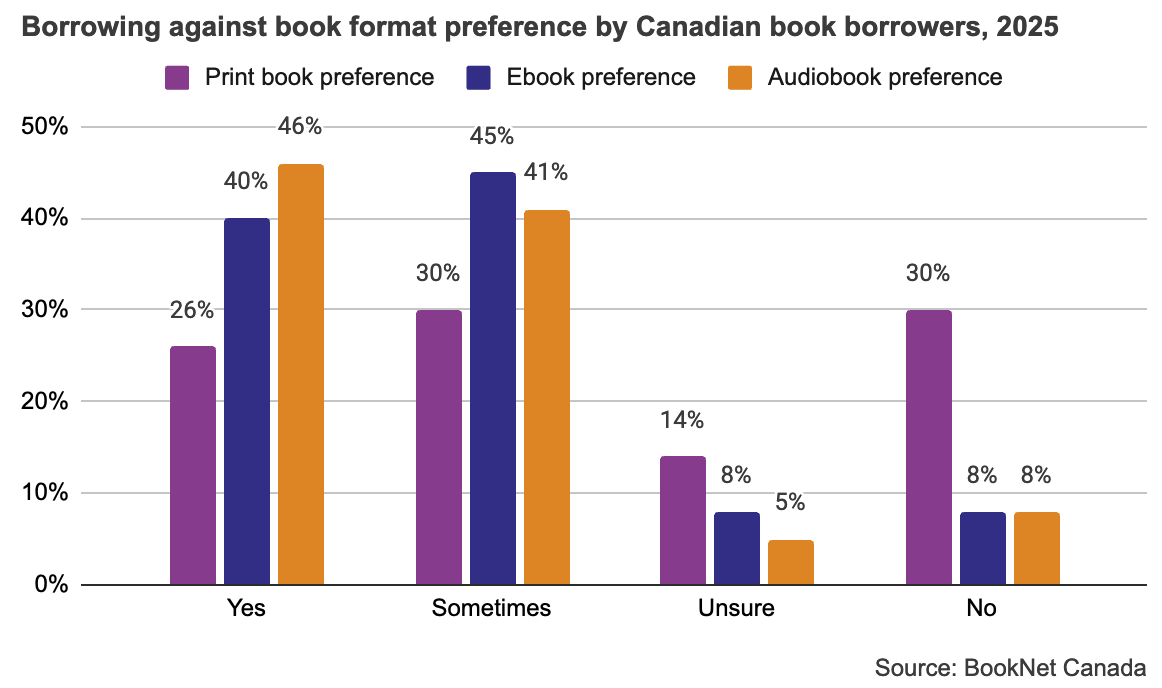
If their preferred format isn’t available, 30% of Canadian book borrowers in 2025 would borrow a book in another format, another third would sometimes borrow a book in another format (34%), and about a quarter would not borrow a book in another format (24%). The remaining Canadian book borrowers were unsure (12%). The graph below shows this question broken down by format preference. Here, Canadian book borrowers who prefer ebooks or audiobooks are the most likely groups to borrow a book in another format if their preferred format is not available.
While most Canadian book borrowers borrowed only books from the library in 2025 (74%), some book borrowers also borrowed or used other things from the library, like DVDs (10%) and magazines (6%).
Similar to past years, Canadian book borrowers borrowed, rather than bought, books for these top reasons in 2025:
To save money — 58%; up from 52% in 2024
I don't want to spend money on it — 44%
I want to read it, but don’t want to own it (or have others to see that I’m reading it) — 35%
To support my local library — 33%
It was too expensive to buy — 23%
Over half of Canadian book borrowers also bought new books
Almost two-thirds of Canadian book borrowers only borrowed books for themselves in 2025 (64%, up from 61% in 2024). Other Canadian book borrowers also borrowed books for:
a young child aged 0–3 — 3%;
a young child aged 4–7 — 9%;
a middle grade child aged 8–12 — 8%;
a young adult aged 13–17 — 9%; and/or
an adult aged 18 or over — 15%.
About a quarter of Canadian book borrowers lived alone in their household in 2025 (24%). Of the the remaining 76%, 41% lived with children:
Under 3 years of age — 5%;
3–5 years of age — 10%;
6–8 years of age — 9%;
9–10 years of age — 5%;
11–12 years of age — 5%; and/or
13–17 years of age — 22%.
Canadian book borrowers became aware of the books they borrowed in 2025 in a number of ways:
Browsing genre/subject area — 43%
Having searched specifically for this book — 38%
Browsing books by author/illustrator — 33%
Read other books by the author/illustrator — 30%
Having searched for another book — 21%
The most popular social media sites among Canadian book borrowers in 2025 were Facebook (65%), YouTube (62%), and Instagram (45%). That being said, 57% of Canadian book borrowers visited book-specific online social network sites or communities (e.g., 49th Shelf, LibraryThing, Goodreads, etc.) in 2025.
Altogether 67% of Canadian book borrowers saw marketing campaigns or ads for the types of books they were interested in (20% yes and 47% sometimes).
Canadian book borrowers also got books in other ways in 2025:
55% bought new books
29% bought secondhand books
27% received books for free (including free downloads)
27% received books as a gift
22% borrowed books from someone they know
Want to know more about Canadian book consumers? Keep your eyes on our blog for more insights and sign up for the research newsletter to be the first to know about all our upcoming research!






Get a free copy of the study in PDF or EPUB format today!