This is the final instalment in our series sharing the results from BookNet’s consumer surveying. In past posts, we’ve looked at the book buying and book borrowing habits of Canadians in 2025. In this post we dive into book prices — how much Canadian book buyers are willing to pay, how Canadian book buyers are spending their money, and the value they attribute to books.
The Canadian Book Consumer survey has been active since 2012, and is our annual survey of Canadians and Canadian book consumers. In it, we survey Canadians quarterly about their book buying, borrowing, and other book-related behaviours. In 2025, we surveyed 1,979 Canadians — 49% bought new books, 24% borrowed books from the library, 19% of Canadians bought used books, and 17% of Canadians also received books for free.
Let’s get in to book pricing.
Most people paid full price for the books they purchased in 2025
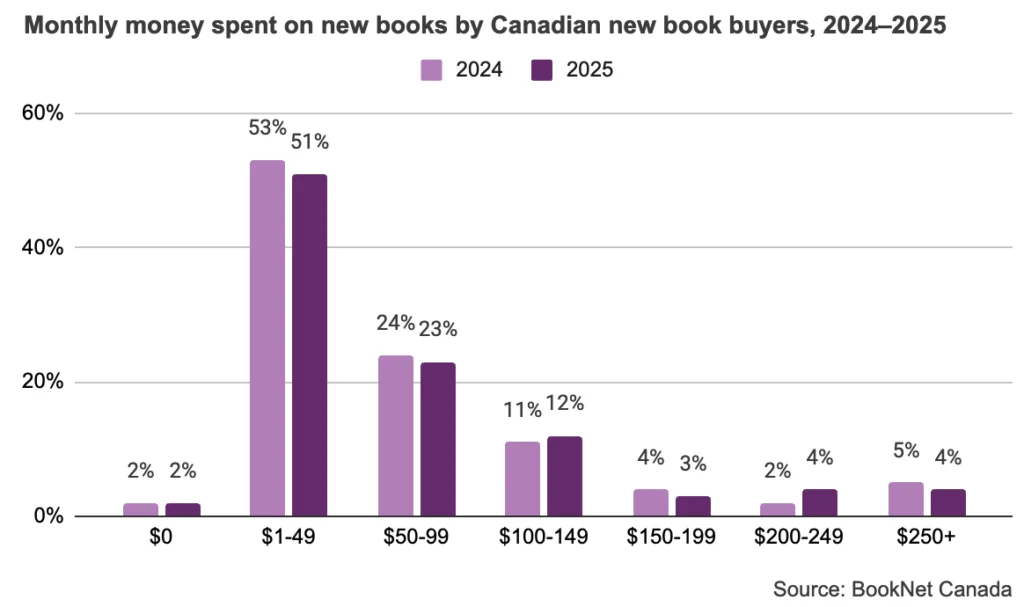
In 2025, about half of Canadians buying new books spent between $1 and $49 on books in a given month (51%). Shown in the graph below, this percentage is down from 53% of new book buyers in 2024.
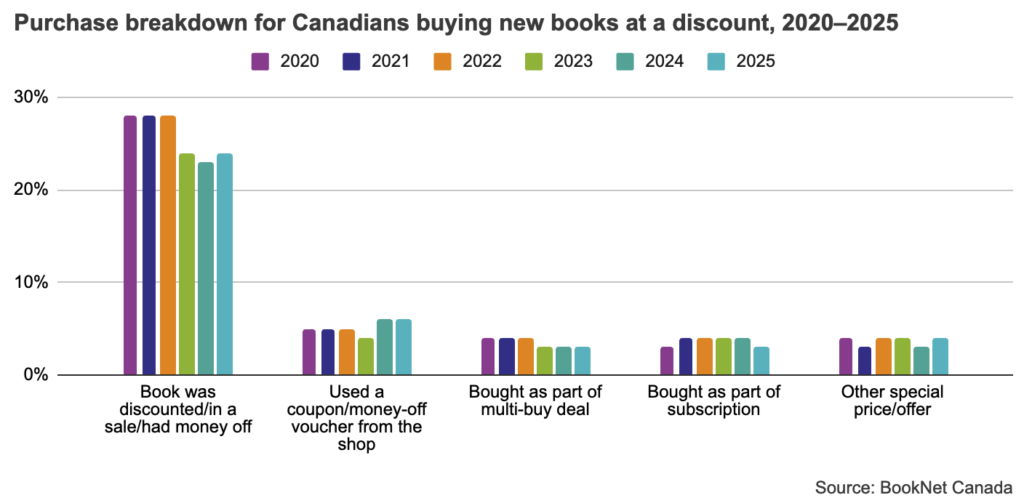
While 91% of Canadians who bought new books looked for sales, promotions, and coupons when they shop for books, most of them paid full price for the books they purchased in 2025 (60%, same as in 2024). The graph below shows what kinds of discounts the 40% who did not pay full price used when purchasing their books.
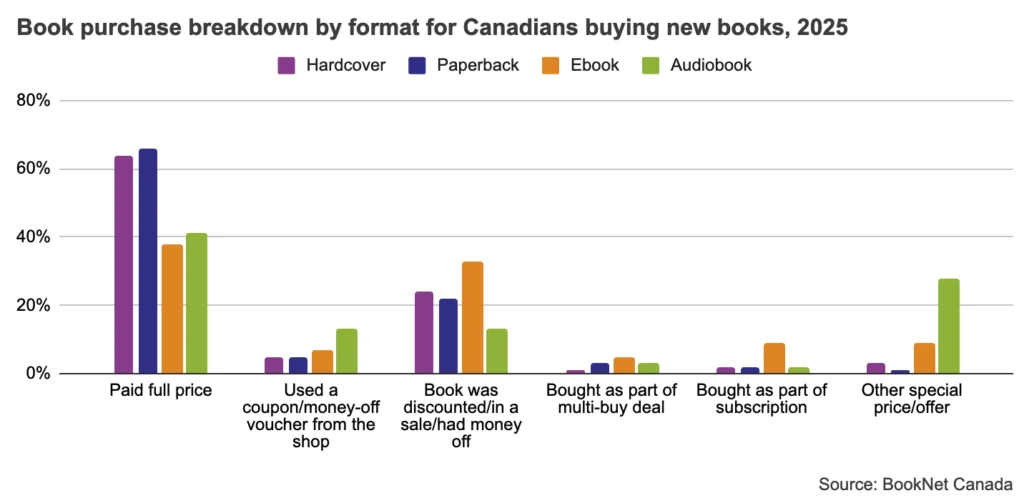
Format by format, full price purchases were most likely to be paperbacks (66%) or hardcovers (64%), rather than ebooks (38%) or audiobooks (41%), shown in the graph below.
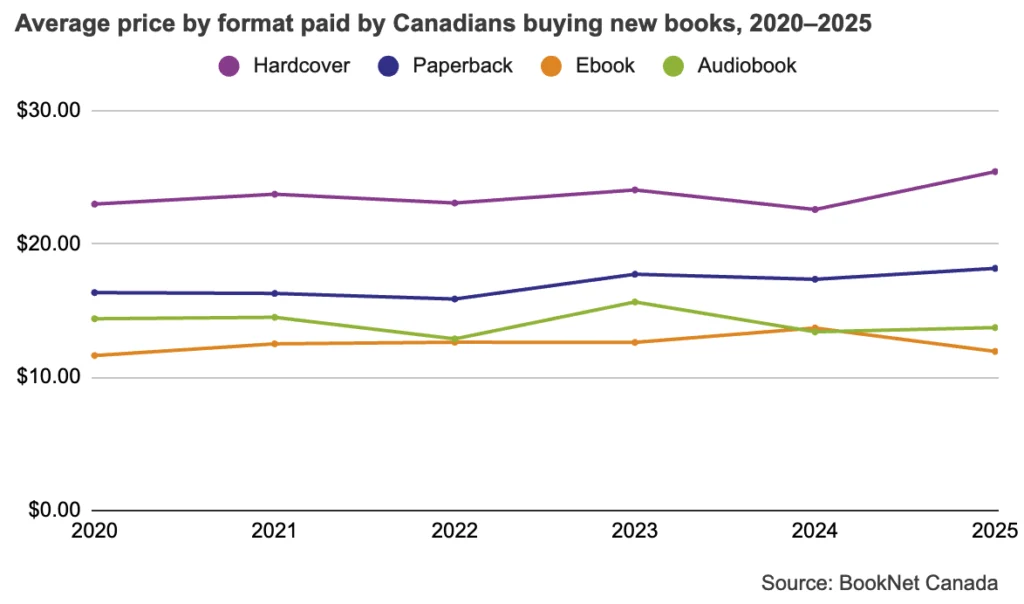
In 2025, Canadians who bought new books spent an average of:
- $25.41 for a hardcover book
- $18.16 for a paperback book
- $11.93 for an ebook
- $13.72 for an audiobook
The average price paid by these Canadian book buyers in 2025 has increased 11% for hardcovers, 11% for paperbacks, 3% for ebooks, and has decreased 5% for audiobooks since 2020. However, average prices paid by consumers have increased 13% for hardcovers, 5% for paperbacks, and 2% for audiobooks, and decreased 13% for audiobooks year over year from 2024 to 2025, shown in the graph below.
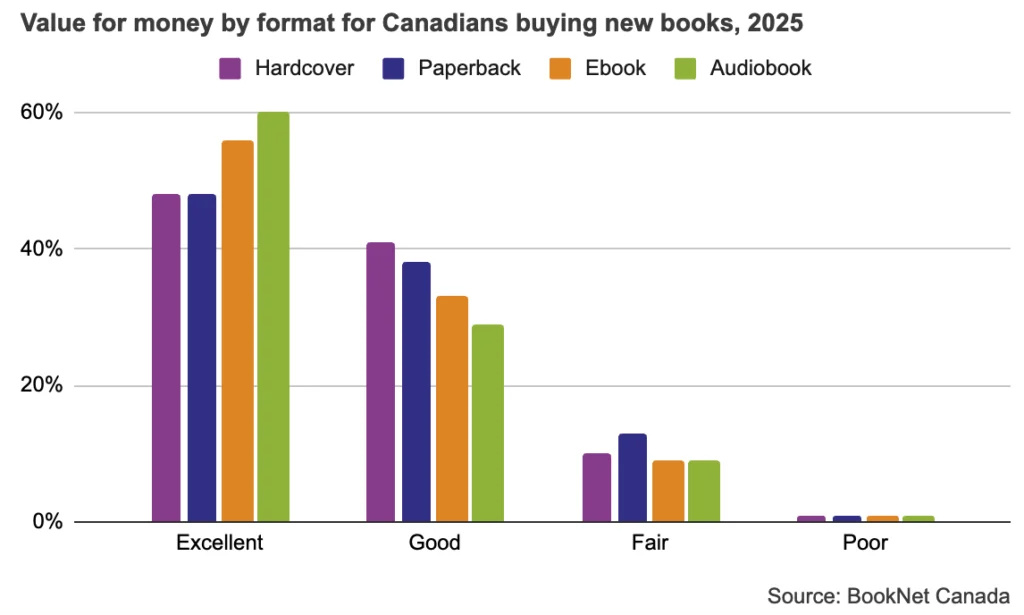
Even with these fluctuations in average prices, half of Canadians buying new books rated their value for money as excellent (50% in 2025, up from 47% in 2024), while 37% rated it as good, 11% as fair, and 1% as poor. Value for money varies format by format, as shown in the graph below. Audiobooks had the highest rating of value for money, with 60% rating them as excellent.
Almost as many Canadians buying new books in 2025 chose books within their budget (48%) as had no limitations or restrictions on what or how many books they bought (49%), and the rest were unsure (4%).
The majority of Canadians who bought new books compared book prices before making a purchase at least sometimes in 2025 (83%). And 19% of new book buyers compared the price in multiple places when deciding whether or not to buy or borrow books — this percentage is the same as in 2023 and 2024. In 2025, 13% of Canadians buying new books decided to buy a book because it was on special offer or had a low price, down from 15% in 2024. Another 8% of Canadians bought the new book, rather than borrowed, because it was cheap.
Book prices were also a factor for Canadians who bought new when deciding where to make their purchase. In 2025, these book buyers chose to shop at one location over another because:
- The book was at a good price/offer/promo — 29%
- There was cheap/free delivery — 16%
- They have a loyalty card/account/subscription — 13%
Overall, 68% of Canadians who bought a new book participated in book-related rewards or loyalty programs in 2025.
Similar to 2024, most book purchases by Canadians buying new books in 2025 were spontaneous to some degree (60%), with 40% being planned purchases:
- 26% had planned to buy a particular book, but not necessarily at that specific time
- 17% were planning to buy a book at that specific time, but had not planned to buy a particular book
- 15% were not planning to buy a book at that specific time, it was an impulse purchase
These buyers of new books paid attention to book prices in other ways, too:
- 68% preferred to pay for a bundle of content more so than buying one single item (down from 71% in 2024)
- 67% added books to their online cart to get free shipping (down from 69% in 2024)
- 50% bought whichever book was least expensive, regardless of its format (print book, ebook, or audiobook) (51% in 2024)
In 2025, 26% of new book buyers also bought books secondhand, and 35% also borrowed books from the library.
Book borrowers looked for sales and promotions on books they bought
Some of the top reasons why book borrowers borrowed books from the library instead of buying them were related to book prices. In 2025:
- 58% borrowed books to save money (up from 52% in 2024)
- 44% borrowed books because they didn’t want to spend money on them (45% in 2024)
- 21% borrowed books because it’s a habit to borrow instead of buy (down from 24% in 2024)
- 23% borrowed books because it was expensive to buy (same as in 2024)
When deciding whether to buy or borrow a book, 45% of Canadian book borrowers checked to see if it was available at their local library in 2025. Another 16% compared the price of the book in multiple places — up from 14% in 2024. Overall, 84% of Canadian book borrowers compared book prices in some capacity before making a purchase in 2025.
Over half of Canadian book borrowers bought new books in 2025 (55%, up from 51% in 2024) and 29% bought secondhand books (up from 27% in 2024).
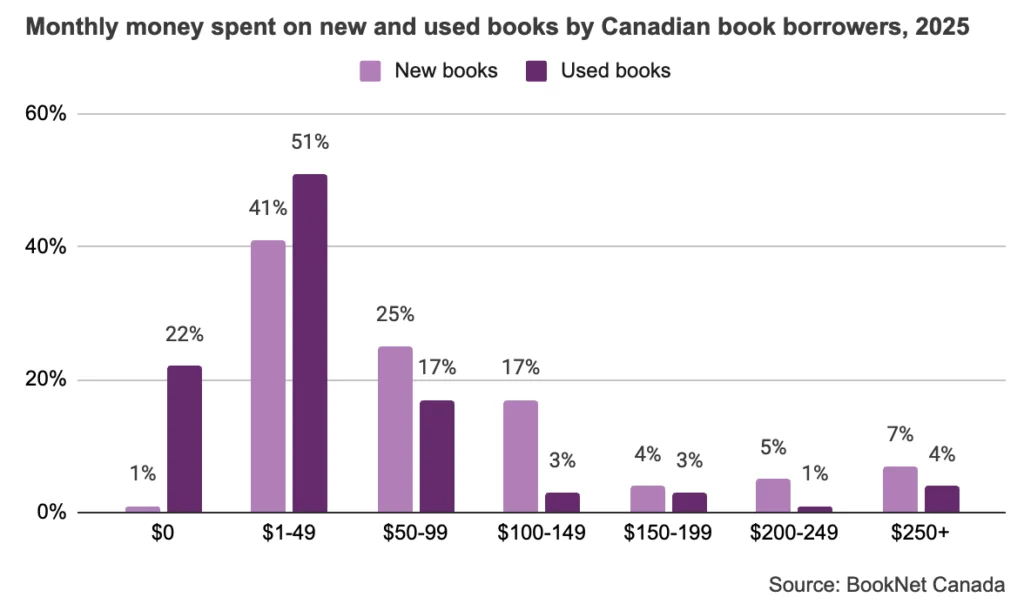
Most borrowers who bought new books or secondhand books spent between $1 and $49 on their book purchases in a given month (51% on used books; 41% on new books). The graph below compares book spending for these two groups of book borrowers.
Overall, all Canadian book borrowers also had frugal book buying habits:
- 84% looked for sales, promotions, and coupons when they shopped for books (same as in 2024)
- 57% preferred to pay for a bundle of content more so than buying one single item (down from 63% in 2024)
- 60% added books to their online cart to get free shipping (down from 64% in 2024)
- 81% bought whichever book was least expensive, regardless of its format (print book, ebook, or audiobook) (up from 80% in 2024)
When buying books, more than half of book borrowers chose books within their budget (52%), while 45% had no limitations or restrictions on what or how many books they bought, and 3% were unsure.
And a significant 61% of book borrowers participated in book-related reward and loyalty programs — similar to the 60% who did in 2024.
That’s a wrap on our dive in to the Canadian Book Consumer results but we’ll be putting out the whole report in June, which will also include some new data on consumer sentiments towards AI. Sign up for the research newsletter to be the first to know when it comes out!