Canadian Book Consumer Study 2025
This report compiles the results from our quarterly surveying of Canadians about their book buying and reading habits in 2025.
In this report you’ll find:
- data on book buying, including insights into spending habits, reasons buyers purchase at specific places, and changes in spending over time;
- data on borrowing, including motivations behind borrowing vs. buying, discoverability, and browsing activity;
- an analysis of the change in the buying and borrowing of print books, ebooks, and audiobooks through recent years;
- insights into the impact of rising book prices on Canadian book buyers and borrowers; and
- even more!
Table of Contents
- Introduction
- Highlights
- Canadian book consumers
- Canadian book buyers
- Canadian book borrowers
- The impact of rising book prices
- About BookNet Canada
- Appendix A: Demographics
Introduction
The Canadian Book Consumer Study 2025 is the fourteenth edition of BookNet Canada’s annual Canadian Book Consumer survey. This annual survey of Canadian book consumers tracks their awareness, discovery, selection, and acquisition behaviours.
Like past editions, the Canadian Book Consumer Study 2025 explores Canadian book consumers as book buyers, book borrowers, as well as other profiles. Offering insight into both print and digital marketplaces, this study also traces the impact of the current economic climate on book prices and buying behaviours through year-over-year comparisons.
Methodology
This study relies on data from our annual Canadian Book Consumer survey. The 2025 edition of this survey was fielded twice: in July and December 2025. All told, the study contains data from 1,979 Canadians, 976 of whom were considered book buyers.
- The survey was fielded online through an external provider, to their consumer panel of nearly two million Canadians. The survey was limited to those with internet access who were able and wanted to participate in our panel in exchange for non-monetary incentives as offered by our survey partner (e.g., loyalty reward “point” programs).
- Respondents were English-speaking Canadians, 18 years of age or older, located throughout Canada, and representative of the Canadian population based on age, gender, and geographical region. Selective sampling was based on demographic results from Statistics Canada.
- There is a margin of error of ±3 percentage points at the 95% confidence level, meaning that statistics for this group could fluctuate about 3% in either direction if the survey was fielded to the entire Canadian population.
- The data is unweighted.
This study was prepared by BookNet Canada staff.
Canadian book consumers
Out of all Canadians surveyed for this study, 49% bought new books and 24% borrowed books from the library in a given month in 2025. Across all purchases tracked in 2024, Canadian book buyers bought an average of 3.6 new books a month last year — 1.9 print books, 1.1 ebooks, and 0.6 audiobooks. Meanwhile, Canadian book borrowers borrowed an average of 4.9 books a month in 2025 — 3.6 print books, 0.8 ebooks, and 0.4 audiobooks. This is very similar to 2024.
Compared to all Canadians, book buyers and borrowers were more likely to:
- be younger — 42% of book buyers and 37% of borrowers were under 45 vs. 28% of all Canadians.
- live in a city or urban area — 53% of buyers and 54% of borrowers vs. 48% of all Canadians.
- have a college or university degree — 52% of buyers and 58% of borrowers vs. 51% of all Canadians.
- have a graduate or professional degree — 25% of buyers and 22% of borrowers vs. 18% of all Canadians.
- be employed full time — 51% of buyers and 45% of borrowers vs. 39% of all Canadians.
Full demographic information for Canadian book buyers, Canadians book borrowers, and all Canadians surveyed are available in Appendix A.
Canadians also consumed books in other ways last year. All told, 19% of Canadians bought used books in 2025, at an average of 2.3 print books per month. A total of 13% of Canadians borrowed books from someone they know, at an average of 2.5 books per month — 1.8 print books, 0.4 ebooks, and 0.3 audiobooks. Another 17% of Canadians also received books for free, including free downloads, for an average of 4.8 books per month — 2.4 print books, 2.0 ebooks, and 0.4 audiobooks.
Book consumers were asked, for the first time in 2025, about their desire to know if any aspect of their book had been produced using AI (content, index, back cover copy, etc.). Over half of respondents do, at least some of the time, want to know about AI use (46% of all respondents answered “yes” and 19% “sometimes”). Buyers and borrowers were just as likely to answer “yes” (46% and 47% respectively) but were somewhat more likely to answer sometimes (23% of buyers and 22% of borrowers). It will be interesting to see how this develops in future years as AI possibly becomes more prevalent.
Canadian book buyers
Bookstore visitorship
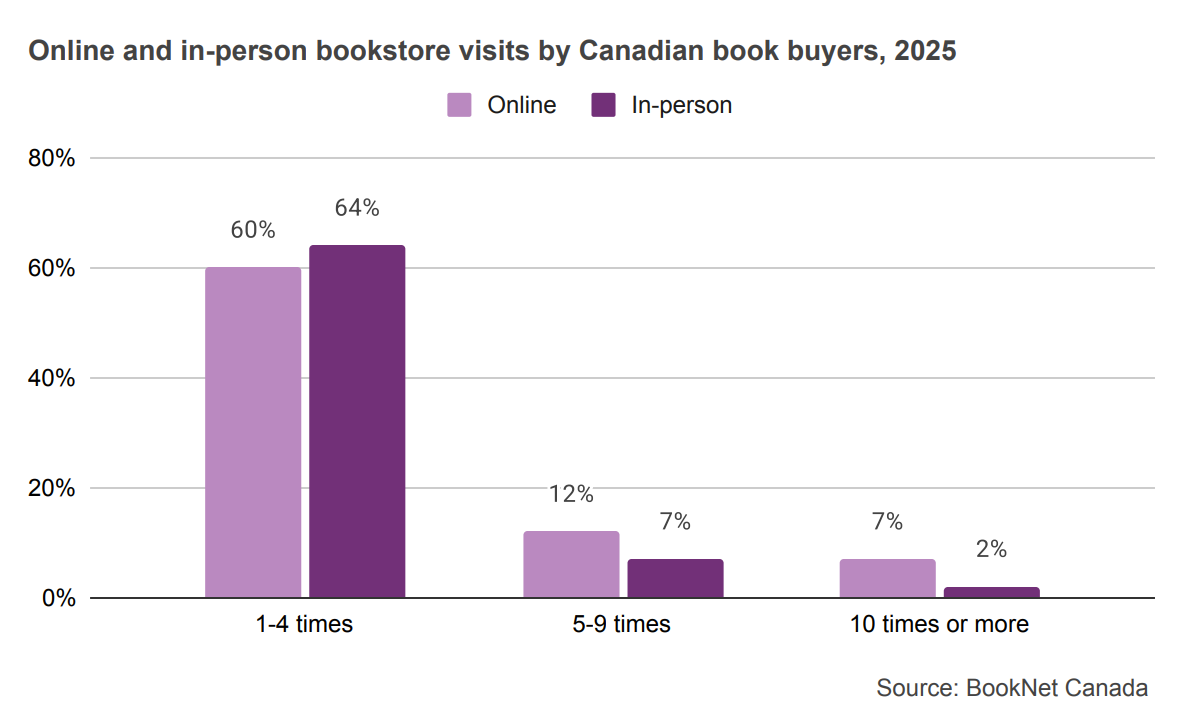
During a given month in 2025, 77% of book buyers visited a bookstore, either online or in person, this is up from 75% in 2024, and up quite dramatically from 63% in 2020. If we break this out by type of bookstore we find that 80% of Canadian book buyers visited a bookstore online and 73% visited a bookstore in-person, up from 71% in 2024.
The graph below shows the frequency of online and in-person bookstore visits by Canadian book buyers in 2025. Most Canadian book buyers visited a bookstore between one and four times in a given month — 60% of online book buyers and 64% of in-person book buyers.
Find our source data here.
Book buyers were asked to select all their reasons for visiting a bookstore in-person in 2025. Here are the top five answers:
- To browse displays and shelves for books to buy — 30%. This is up from 25% in 2024 and has moved into the top spot.
- To browse books to pass time — 28%. Down from 30% in 2024.
- To browse new releases — 28%. Up from 25% in 2024.
- To browse for book deals/sales — 25%. Same as in 2024.
- To buy a gift — 20%. Up from 17% in 2024.
For book buyers visiting bookstores online in 2025, the top reasons were:
- To browse for book deals/sales — 29%. Up from 18% in 2024.
- To browse new releases — 23%. Up from 16% in 2024.
- To check/compare prices — 23%. Up from 16% in 2024.
- To browse books to pass time — 19%. Up from 15% in 2024.
- To look for a specific book to buy it in a specific format — 18%. Up from 12% in 2024.
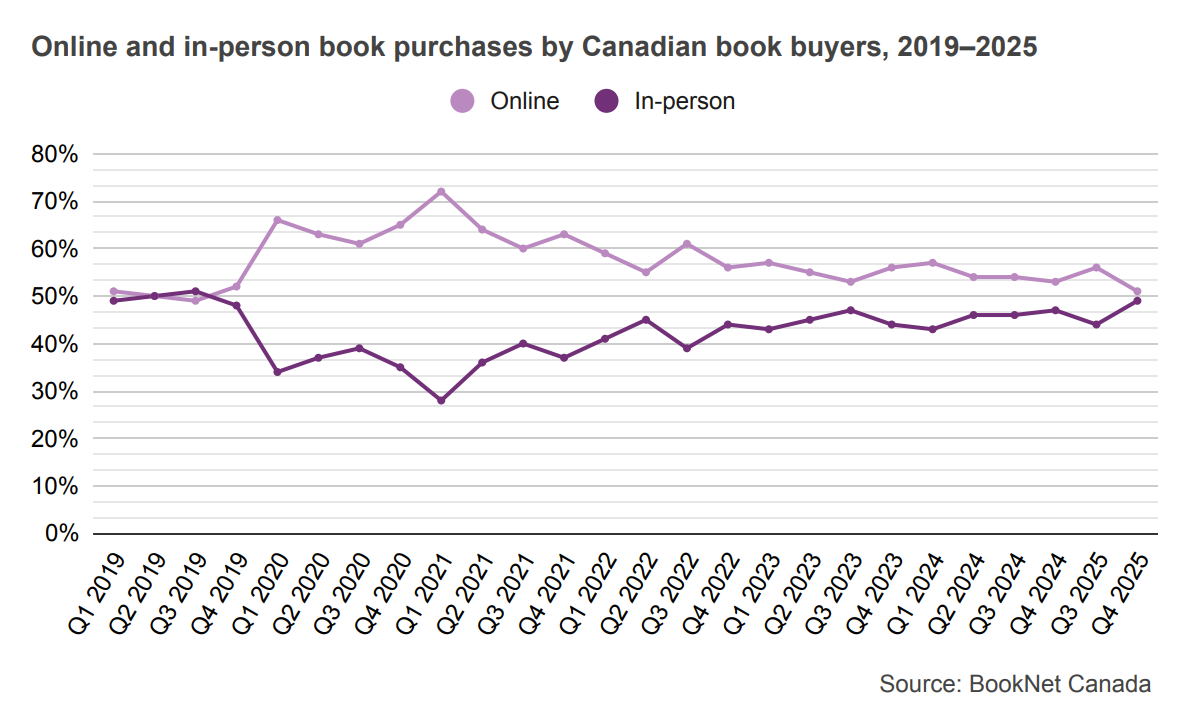
These visits translated into book sales. In 2025, 53% of all book purchases made by these Canadian book buyers were online, while 47% were in-person. Shown in the graph below, if we break these numbers out by quarter, we can see that we have come back to the pre-pandemic 50-50 split of online and in-person purchases.
Find our source data here.
Canadian book buyers purchased their books at a specific location in 2025 for these top reasons:
- Convenient place to shop — 35%. Down from 39% in 2024.
- Good price/offer/promo — 29%. Up from 28% in 2024.
- Book(s) in stock/available immediately — 28%. Up from 29% in 2024.
- Good selection of books — 25%. Up from 24% in 2024.
As in past years, the consumers who bought their books online first found them by searching for a particular book (40%). And while those who bought their books in-person first saw them on a main shelf (57%), this has increased from 53% in 2024.
While 40% of Canadian book buyers had planned to buy a particular book at a specific time, most book purchases in 2025 were at least in some part spontaneous:
- 26% had planned to buy a particular book, but not necessarily at that specific time
- 17% were not planning to buy a book at that specific time, it was an impulse purchase
- 17% were planning to buy a book at that specific time, but had not planned to buy a particular book
Book buying by format and subject
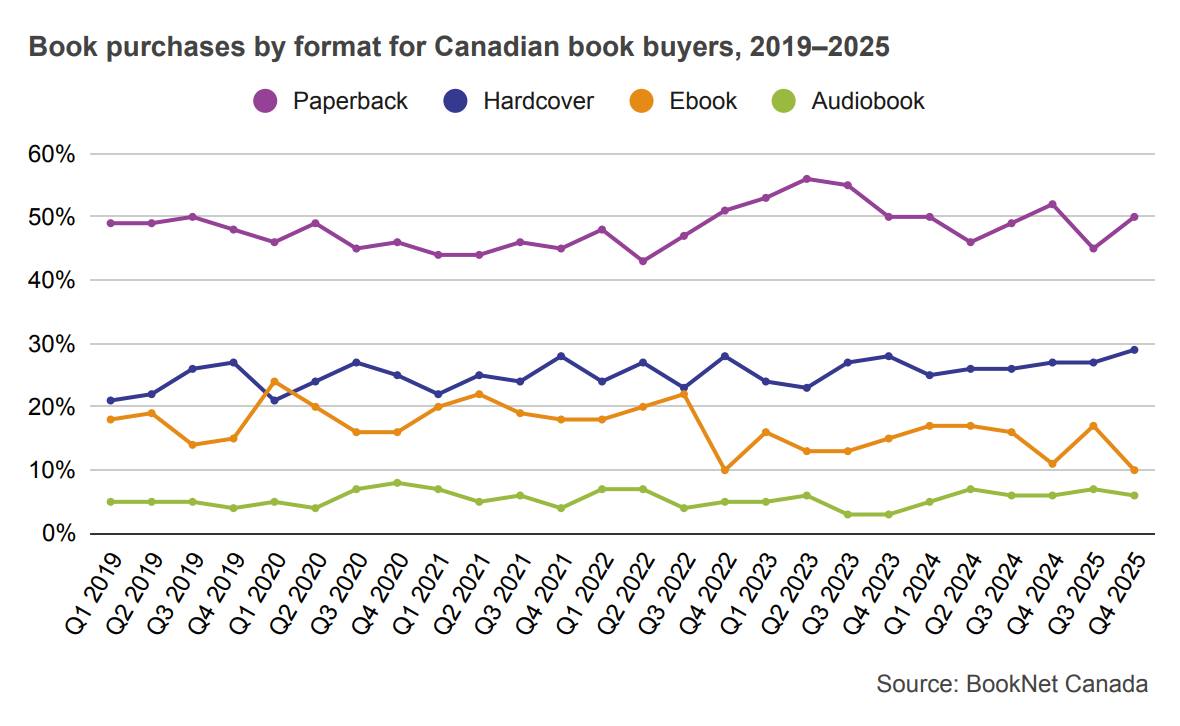
Canadian book buyers in 2025 purchased books in a variety of formats. Similar to past years, the majority of purchases were for print books (76%) — 48% paperback and 28% hardcover. In 2025, 14% of books purchased by book buyers were ebooks and 7% were audiobooks. The graph below shows this format breakdown over time, quarter-by-quarter.
Find our source data here.
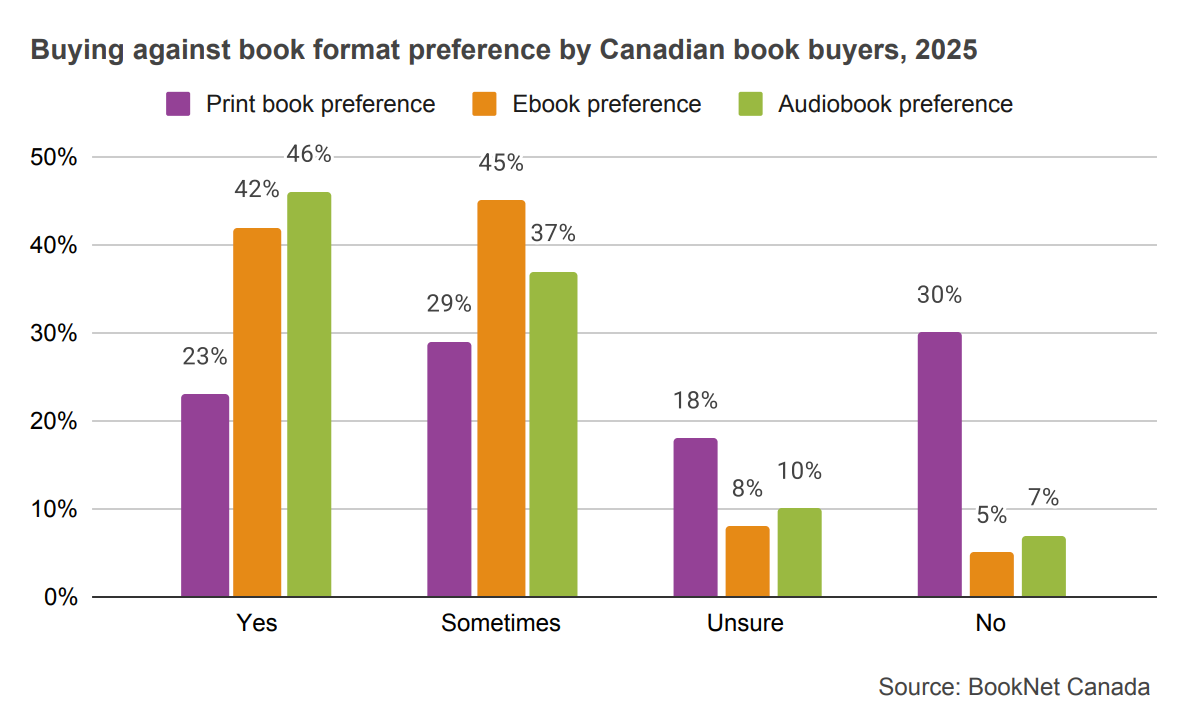
When asked about their format preferences, most Canadian book buyers preferred print books (71%), while others preferred ebooks (15%) or audiobooks (9%). But if their preferred book format wasn’t available, over a quarter said they would choose to get the book in another format (28%), a third said sometimes (33%), and a quarter said no (24%). The rest of Canadian book buyers were unsure (15%).
Breaking these responses down by format preference, Canadian book buyers who prefer ebooks or audiobooks are most likely to purchase a book in another format if their preferred format is not available (46% for audiobook listeners and 42% for ebook readers), as shown in the graph below. Print readers were the least likely; 30% said they would not get the book in another format.
Find our source data here.
Like in past years, Canadian book buyers in 2025 were most likely to spend $1 to $49 on books in a given month (51%), while others spent $50 to $99 (23%) or $100 or more (23%). Three quarters of the books purchased were Adult titles (75%), though some were Young Adult (17%) and Juvenile titles (9%).
The majority of books bought in 2025 were Fiction titles (62%). The top Fiction subject categories purchased by Canadian book buyers were Fantasy (17%), Suspense or Thriller (16%), and Mystery/Detective (13%). The remaining books were Non-Fiction titles (38%). Canadian book buyers in 2025 purchased Biography or Memoir (20%), Self-Help (19%), and History (13%) as the top Non-Fiction subject categories.
In 2025, Canadian book buyers continued to search for:
- books by Canadian authors/illustrators — 38%, up from 32% in 2024;
- books about Canada or regions within Canada — 29%, up from 27% in 2024; and
- books about a group or culture written by people from that group or culture — 22%, same as in 2024.
Other book buying behaviours
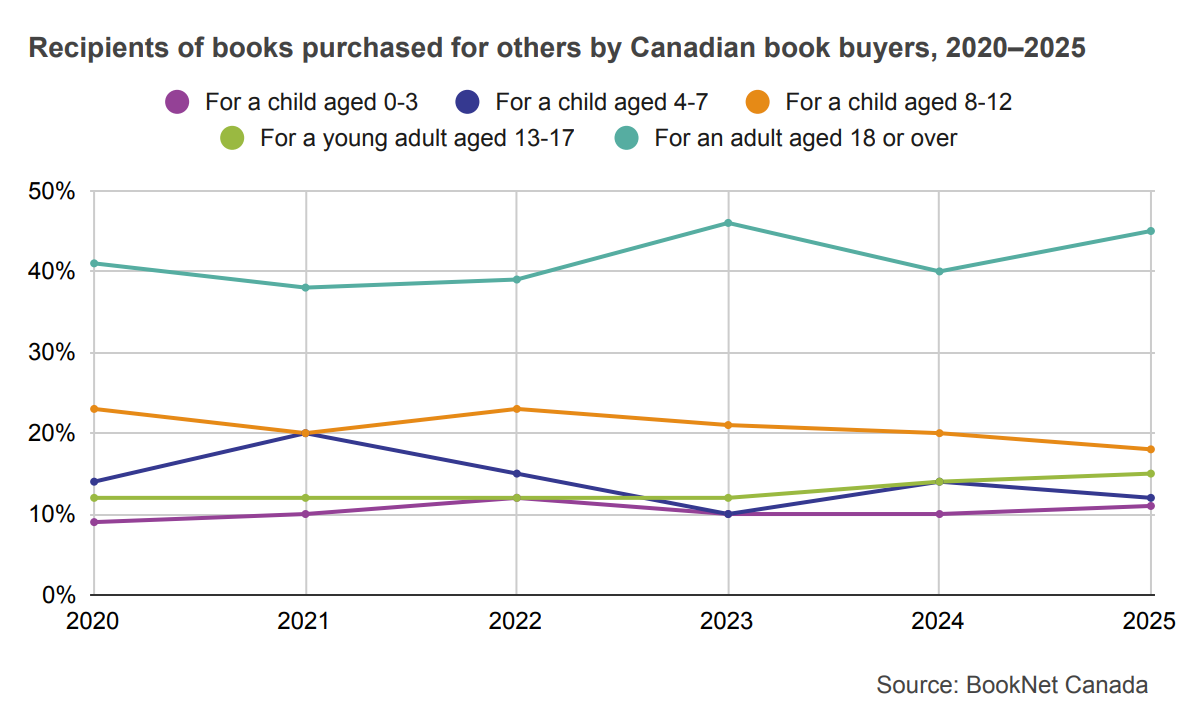
Most Canadian book buyers bought books for themselves in 2025 (84%, down from 86% in 2024), but some bought books for someone else either as a gift (14%) or just because (2%). In 2025, Canadian book buyers bought books for a range of other people. Canadian book buyers bought books for children and young adults under 18 (55%) and other adults (45%), shown in the graph below. The age breakdown for books bought as gifts for those under 18:
- a young adult aged 13 to 17 — 15%
- a middle grade child aged 8 to 12 — 18%
- a young child aged 4 to 7 — 12%
- a young child aged 0 to 3 — 11%
Find our source data here.
Canadian book buyers bought books instead of borrowing them in 2025 for these main reasons:
- wanted it right away — 14%
- wanted to be able to reread it whenever they want, as much as they want — 13%
- wanted to own it for their display, collection, or archive — 11%.
In 2025, most Canadian book buyers became aware of the books they purchased from a recommendation or review (22% in 2025, up from 19% in 2024). They also found them by browsing or searching online or in-person (19%) or because they had read other books by the same author/illustrator (18%).
For the first time in 2025, we asked about the impact of AI on book awareness, however, only 3% of buyers became aware of the book they bought when it was suggested by an AI tool (ChatGPT, Claude, etc.).
The top reasons buyers decided to purchase a book in 2025 were an interest in the book’s subject (32% in 2025, up from 29% in 2024), the description of the book (20%), a recommendation or review (18%), or they liked the series (17%).
The most popular social media sites among Canadian book consumers were YouTube (65%), Facebook (64%), and Instagram (45%). Over half of Canadian book buyers visited book-specific online social network sites/communities (e.g., 49th Shelf, LibraryThing, Goodreads, etc.) in 2025 (56%). Only 16% of Canadian book buyers left their own reviews online in 2025, which is down from 19% in 2024.
Altogether 70% of Canadian book buyers saw marketing campaigns or ads for the types of books they were interested in in 2024 (23% yes and 47% sometimes).
Canadian book buyers also got books in other ways in 2025:
- 35% borrowed books from the public library
- 26% bought books secondhand
- 28% received books as a gift
- 22% received books for free (including free downloads)
- 15% borrowed books from someone they know
Canadian book borrowers
Library visitorship
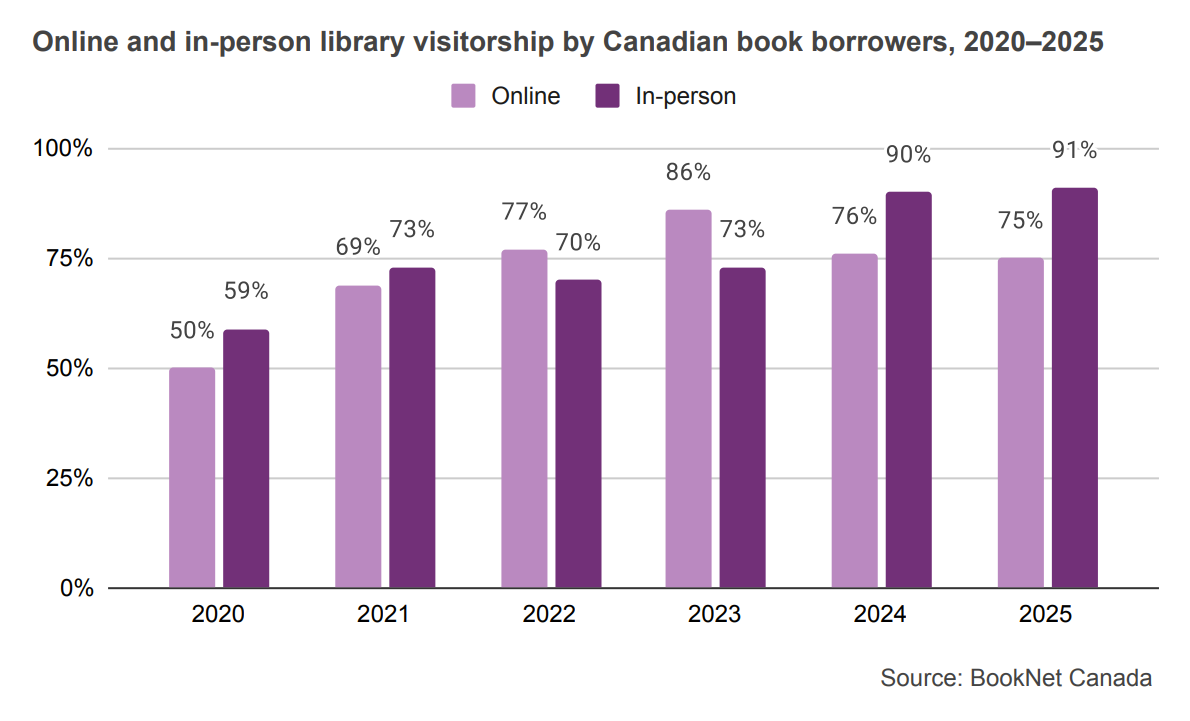
Since 2020, the percentage of Canadian book borrowers who visited the library at least once a month, either in person or online, has generally increased from 54% in 2020 to 83% in 2025. As we can see in the graph below, the share of online visitors has plateaued in 2025 and has slightly decreased from the high in 2023 (86%). The percentage of book borrowers who visited the library in person also plateaued in 2025, but remains quite high at 91%.
Find our source data here.
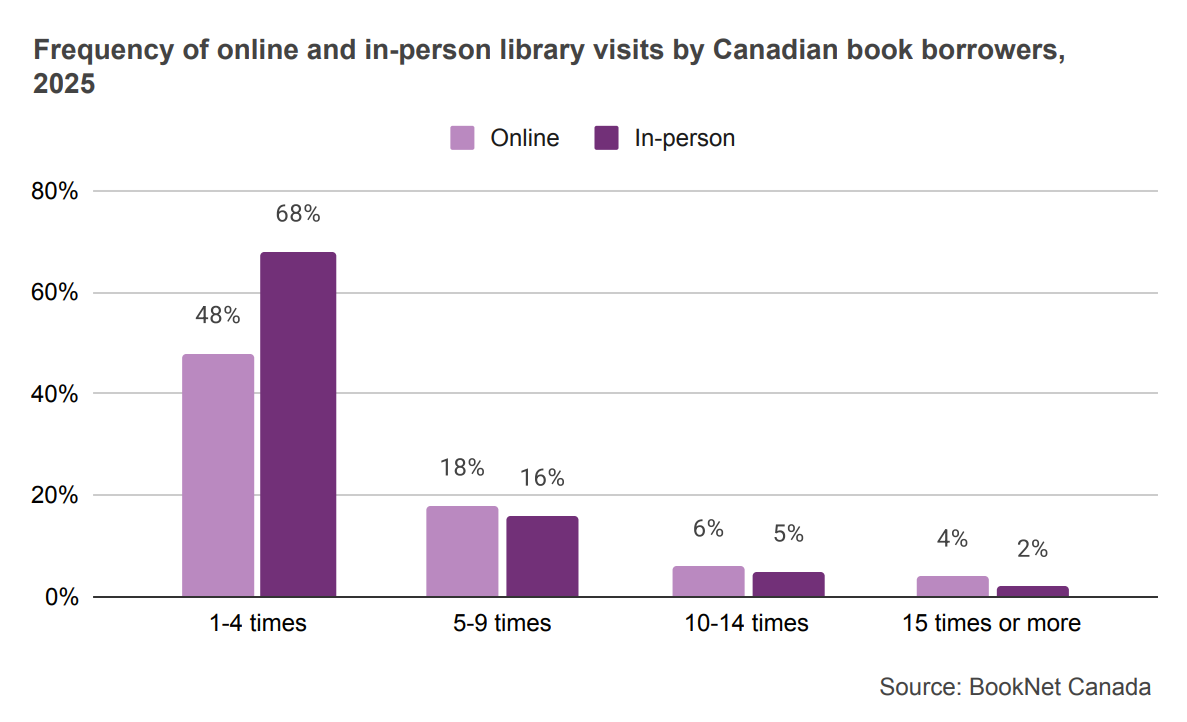
The graph below shows the frequency of these monthly library visits in 2025. Most Canadian book borrowers visit the library one to four times a month — 48% of book borrowers visited online and 68% visited in-person.
Find our source data here.
The most popular reasons for Canadian library book borrowers to visit the library in 2025 were:
- To pick up hold(s) — 49%
- To browse displays and shelves for books to borrow — 38%
- To discover a new book, author, and/or illustrator — 24%
- To put books/materials on hold — 21%
Picking up and putting materials on hold both increased in popularity as reasons to visit the library in 2025. “To pick up holds” increased from 39% in 2024 to 49% in 2025, and “To put books/materials on hold” increased from 16% in 2024 to 21% in 2025.
Book borrowing by format
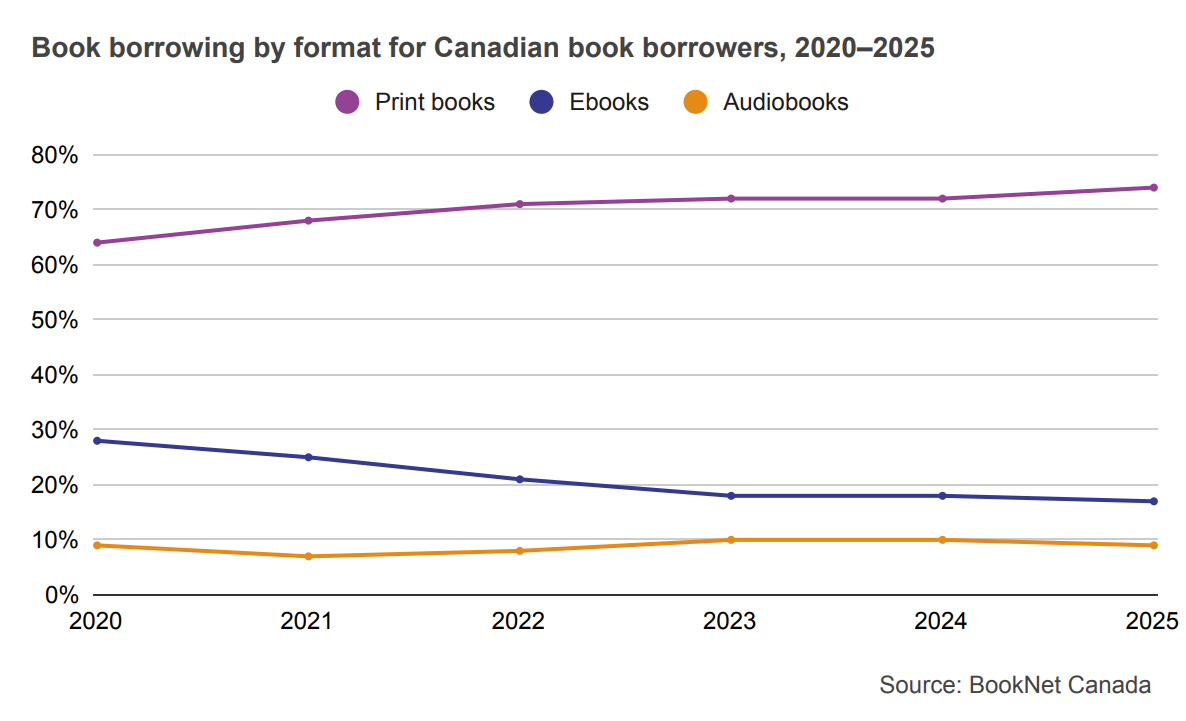
Overall, 74% of all books borrowed by Canadians in 2025 were print books, 17% were ebooks, and 9% were audiobooks, shown in the graph below. On average, Canadian library book borrowers borrowed 4.9 books a month in 2025 — 3.6 print books, 0.8 ebooks, and 0.4 audiobooks. This is very similar to 2024.
Find our source data here.
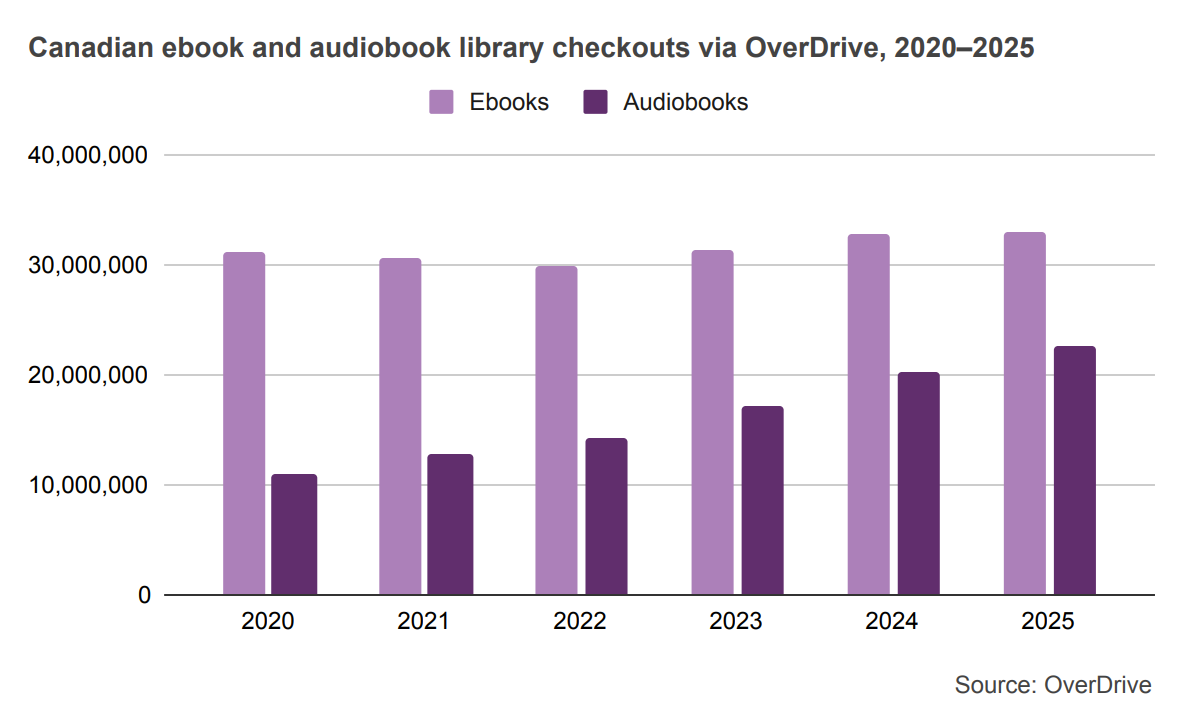
Data provided by OverDrive, the world’s leading digital reading platform for libraries and schools, offers more insight into the library circulation of digital ebooks and audiobooks in Canada. When we look at their data we can see the growth in ebook checkouts seems to have plateaued, but audiobook checkouts continue to increase year over year, a percent change of 11% between 2024 and 2025. In 2025, 59% of all digital library checkouts were ebooks, while 41% were audiobooks.
Find our source data here.
Altogether, 71% of book borrowers chose print books as their preferred book format, while 17% preferred ebooks, 8% preferred audiobooks, and 3% had no format preference. This is a very similar distribution to 2024.
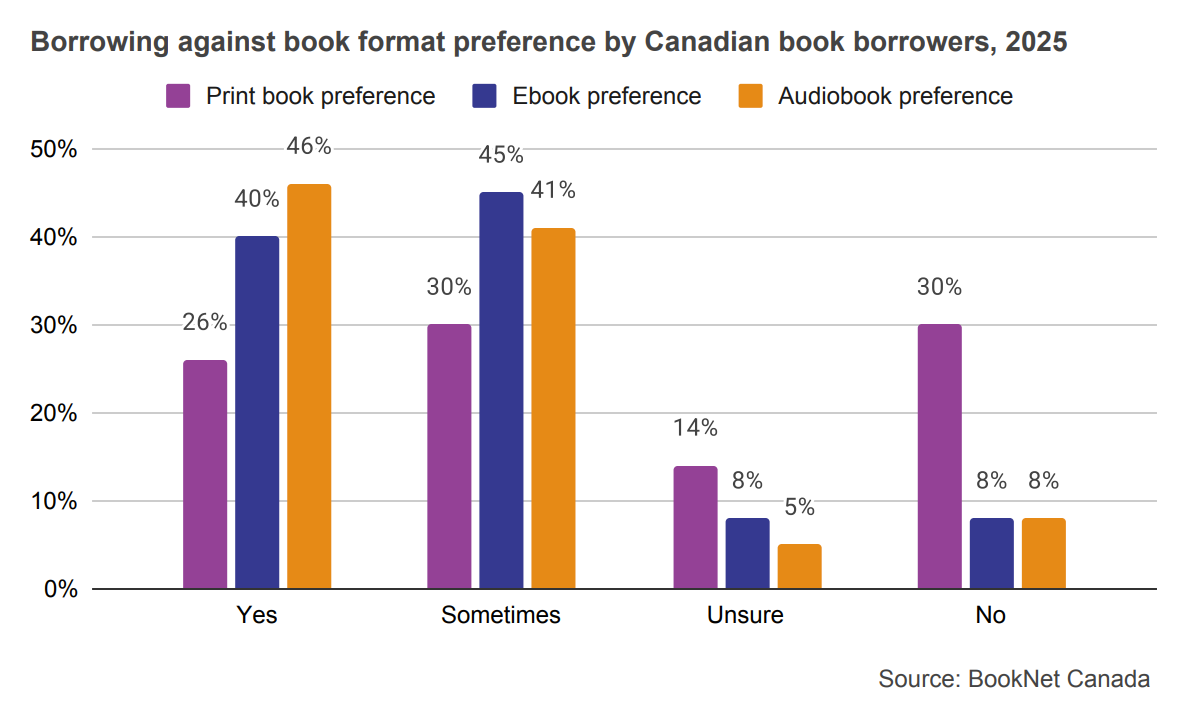
If their preferred format isn’t available, 30% of Canadian book borrowers in 2025 would borrow a book in another format, another third would sometimes borrow a book in another format (34%), and about a quarter would not borrow a book in another format (24%). The remaining Canadian book borrowers were unsure (12%). The graph below shows this question broken down by format preference. Here, Canadian book borrowers who prefer ebooks or audiobooks are the most likely groups to borrow a book in another format if their preferred format is not available.
Find our source data here.
While most Canadian book borrowers borrowed only books from the library in 2025 (74%), some book borrowers also borrowed or used other things from the library, like DVDs (10%) and magazines (6%).
Similar to past years, Canadian book borrowers borrowed, rather than bought, books for these top reasons in 2025:
- To save money — 58%; up from 52% in 2024
- I don’t want to spend money on it — 44%
- I want to read it, but don’t want to own it — 35%
- To support my local library — 33%
- It was too expensive to buy — 23%
Other book borrowing behaviours
Almost two-thirds of Canadian book borrowers only borrowed books for themselves in 2025 (64%, up from 61% in 2024). Other Canadian book borrowers also borrowed books for:
- ● a young child aged 0–3 — 3%;
- a young child aged 4–7 — 9%;
- a middle grade child aged 8–12 — 8%;
- a young adult aged 13–17 — 9%; and/or
- an adult aged 18 or over — 15%.
About a quarter of Canadian book borrowers lived alone in their household in 2025 (24%). Of the remaining 76%, 41% lived with children:
- Under 3 years of age — 5%;
- 3–5 years of age — 10%;
- 6–8 years of age — 9%;
- 9–10 years of age — 5%;
- 11–12 years of age — 5%; and/or
- 13–17 years of age — 22%.
Canadian book borrowers became aware of the books they borrowed in 2025 in a number of ways:
- Browsing genre/subject area — 43%
- Having searched specifically for this book — 38%
- Browsing books by author/illustrator — 33%
- Read other books by the author/illustrator — 30%
- Having searched for another book — 21%
However, book borrowers were not influenced by AI tools in terms of book awareness; 0% of book borrowers cited AI tools as a driver of awareness for the books they borrowed and only 1% of book buyers said they became aware of the book they borrowed through an AI tool.
The most popular social media sites among Canadian book borrowers in 2025 were Facebook (65%), YouTube (62%), and Instagram (45%). That being said, 57% of Canadian book borrowers visited book-specific online social network sites or communities (e.g., 49th Shelf, LibraryThing, Goodreads, etc.) in 2025.
Altogether 67% of Canadian book borrowers saw marketing campaigns or ads for the types of books they were interested in (20% yes and 47% sometimes).
Canadian book borrowers also got books in other ways in 2025:
- 55% bought new books
- 29% bought secondhand books
- 27% received books for free (including free downloads)
- 27% received books as a gift
- 22% borrowed books from someone they know
The impact of rising book prices
Buying books new
In 2025, about half of Canadians buying new books spent between $1 and $49 on books in a given month (51%). Shown in the graph below, this percentage is down from 53% of new book buyers in 2024.

Find our source data here.
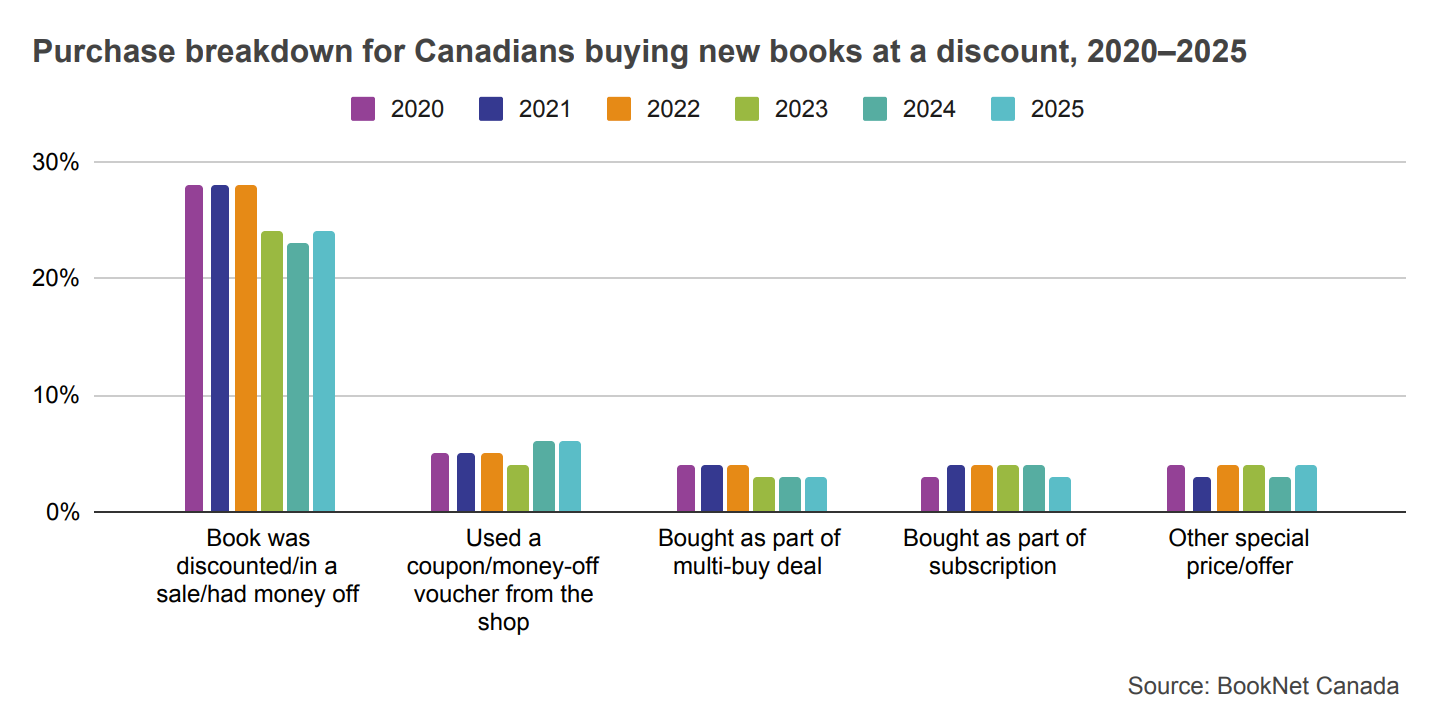
While 91% of Canadians who bought new books looked for sales, promotions, and coupons when they shop for books, most of them paid full price for the books they purchased in 2025 (60%, same as in 2024). The graph below shows what kinds of discounts the 40% who did not pay full price used when purchasing their books.
Find our source data here.
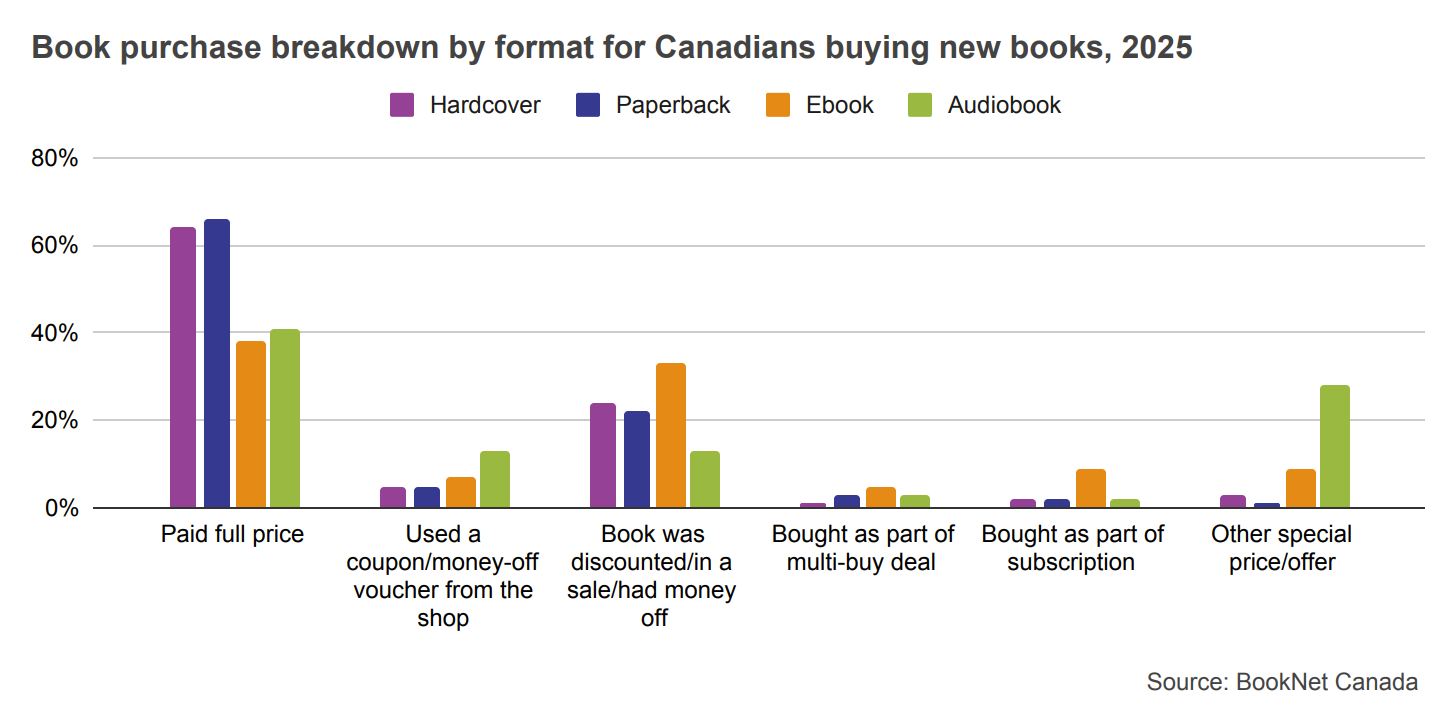
Format by format, full price purchases were most likely to be paperbacks (66%) or hardcovers (64%), rather than ebooks (38%) or audiobooks (41%), shown in the graph below.
Find our source data here.
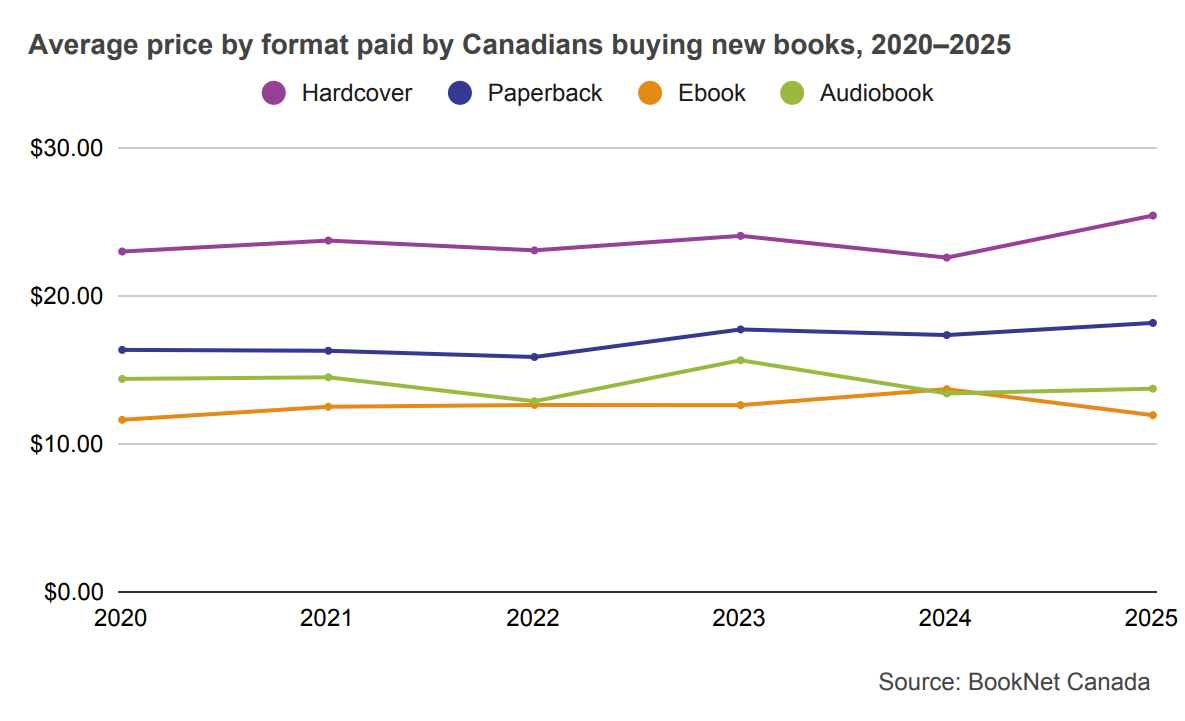
In 2025, Canadians who bought new books spent an average of:
- $25.41 for a hardcover book
- $18.16 for a paperback book
- $11.93 for an ebook
- $13.72 for an audiobook
The average price paid by these Canadian book buyers in 2025 has increased 11% for hardcovers, 11% for paperbacks, 3% for ebooks, but has decreased 5% for audiobooks since 2020. However, average prices paid by consumers have increased 13% for hardcovers, 5% for paperbacks, and 2% for audiobooks, and decreased 13% for audiobooks year over year from 2024 to 2025, shown in the graph below.
Find our source data here.
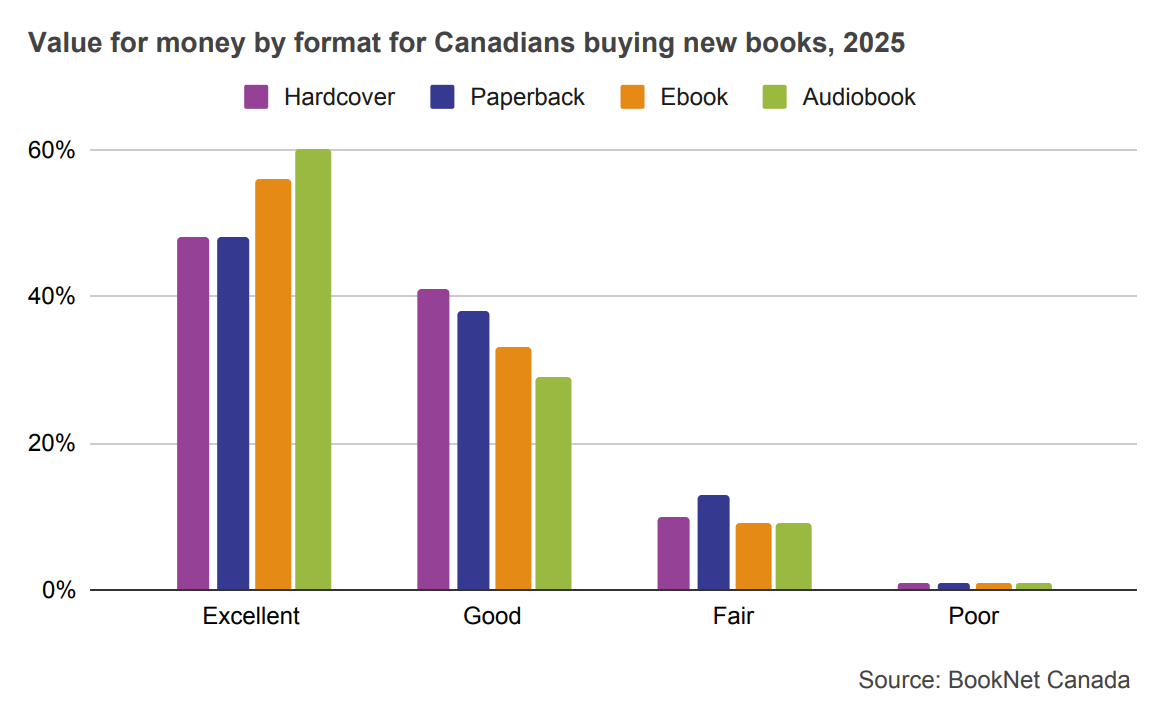
Even with these fluctuations in average prices, half of Canadians buying new books rated their value for money as excellent (50% in 2025, up from 47% in 2024), while 37% rated it as good, 11% as fair, and 1% as poor. Value for money varies format by format, as shown in the graph below. Audiobooks had the highest rating of value for money, with 60% rating them as excellent.
Find our source data here.
Almost as many Canadians buying new books in 2025 chose books within their budget (48%) as had no limitations or restrictions on what or how many books they bought (49%), and the rest were unsure (4%).
The majority of Canadians who bought new books compared book prices before making a purchase at least sometimes in 2025 (83%). And 19% of new book buyers compared the price in multiple places when deciding whether or not to buy or borrow books — this percentage is the same as in 2023 and 2024. In 2025, 13% of Canadians buying new books decided to buy a book because it was on special offer or had a low price, down from 15% in 2024. Another 8% of Canadians bought the new book, rather than borrowed, because it was cheap.
Book prices were also a factor for Canadians who bought new when deciding where to make their purchase. In 2025, these book buyers chose to shop at one location over another because:
- The book was at a good price/offer/promo — 29%
- There was cheap/free delivery — 16%
- They have a loyalty card/account/subscription — 13%
Overall, 68% of Canadians who bought a new book participated in book-related rewards or loyalty programs in 2025.
Similar to 2024, most book purchases by Canadians buying new books in 2025 were spontaneous to some degree (60%), with 40% being planned purchases:
- 26% had planned to buy a particular book, but not necessarily at that specific time
- 17% were planning to buy a book at that specific time, but had not planned to buy a particular book
- 15% were not planning to buy a book at that specific time, it was an impulse purchase
These buyers of new books paid attention to book prices in other ways, too:
- 68% preferred to pay for a bundle of content more so than buying one single item (down from 71% in 2024)
- 67% added books to their online cart to get free shipping (down from 69% in 2024)
- 50% bought whichever book was least expensive, regardless of its format (print book, ebook, or audiobook) (51% in 2024)
In 2025, 26% of new book buyers also bought books secondhand, and 35% also borrowed books from the library.
Borrowing books
Some of the top reasons why book borrowers borrowed books from the library instead of buying them were related to book prices. In 2025:
- 58% borrowed books to save money (up from 52% in 2024)
- 44% borrowed books because they didn’t want to spend money on them (45% in 2024)
- 21% borrowed books because it’s a habit to borrow instead of buy (down from 24% in 2024)
- 23% borrowed books because it was expensive to buy (same as in 2024)
When deciding whether to buy or borrow a book, 45% of Canadian book borrowers checked to see if it was available at their local library in 2025. Another 16% compared the price of the book in multiple places — up from 14% in 2024. Overall, 81% of Canadian book borrowers compared book prices in some capacity before making a purchase in 2025.
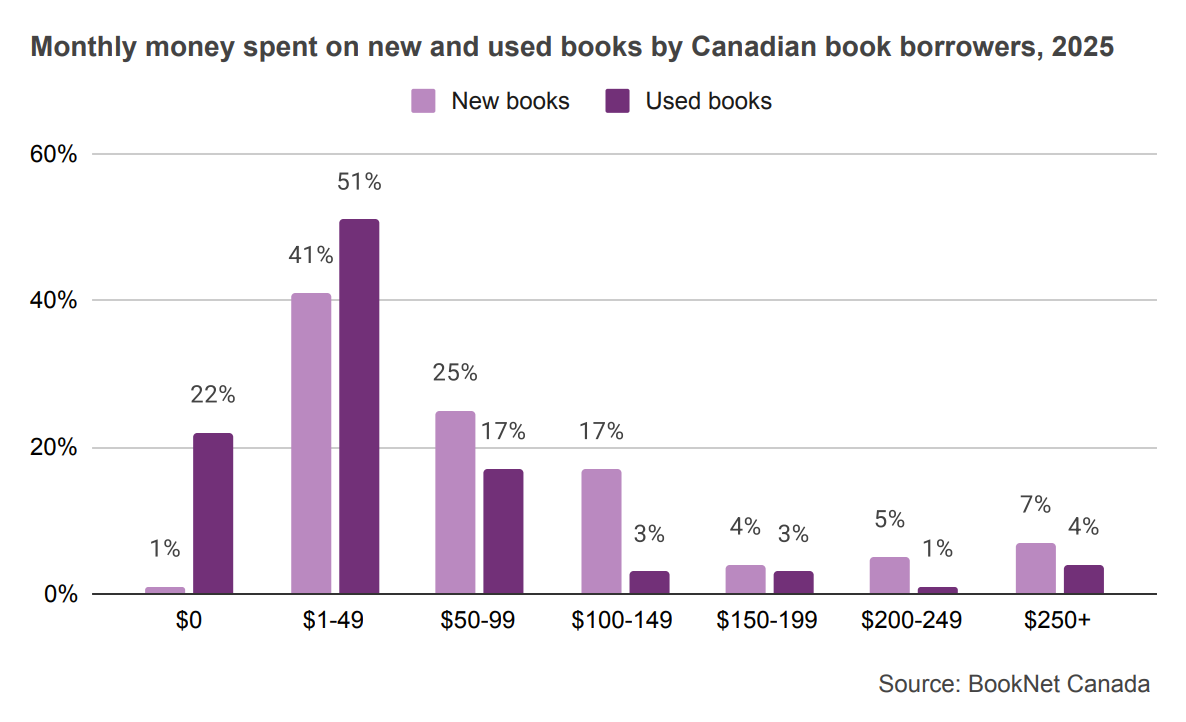
Over half of Canadian book borrowers bought new books in 2025 (55%, up from 51% in 2024) and 29% bought secondhand books (up from 27% in 2024).
Most borrowers who bought new books or secondhand books spent between $1 and $49 on their book purchases in a given month (51% on used books; 41% on new books). The graph below compares book spending for these two groups of book borrowers.
Find our source data here.
Overall, all Canadian book borrowers also had frugal book buying habits:
- 84% looked for sales, promotions, and coupons when they shopped for books (same as in 2024)
- 57% preferred to pay for a bundle of content more so than buying one single item (down from 63% in 2024)
- 60% added books to their online cart to get free shipping (down from 64% in 2024)
- 52% bought whichever book was least expensive, regardless of its format (print book, ebook, or audiobook) (up from 50% in 2024)
When buying books, more than half of book borrowers chose books within their budget (52%), while 45% had no limitations or restrictions on what or how many books they bought, and 3% were unsure.
And a significant 61% of book borrowers participated in book-related reward and loyalty programs — similar to the 60% who did in 2024.
About BookNet Canada
BookNet Canada is a non-profit organization that develops technology, standards, and education to serve the Canadian book industry. Founded in 2002 to address systemic challenges in the industry, BookNet Canada supports publishing companies, booksellers, wholesalers, distributors, sales agents, and libraries across the country.
BookNet Canada acknowledges that its operations are remote and our colleagues contribute their work from the traditional territories of the Mississaugas of the Credit, the Anishinaabe, the Haudenosaunee, the Wyandot, the Mi’kmaq, the Ojibwa of Fort William First Nation, the Three Fires Confederacy of First Nations (which includes the Ojibwa, the Odawa, and the Potawatomie), the Métis, as well as the unceded and ancestral territory of the Musqueam, Squamish, or Tsleil-Waututh peoples, the original nations and peoples of the lands we now call Beeton, Guelph, Halifax, Thunder Bay, Toronto, Vancouver, Vaughan, and Windsor. We endorse the Calls to Action from the Truth and Reconciliation Commission of Canada and support an ongoing shift from gatekeeping to spacemaking in the book industry.
The book industry has long been an industry of gatekeeping. Anyone who works at any stage of the book supply chain carries a responsibility to serve readers by publishing, promoting, and supplying works that represent the wide extent of human experiences and identities, in all its complicated intersectionality. We, at BookNet Canada, are committed to working with our partners in the industry as we move towards a framework that supports “spacemaking,” which ensures that marginalized creators and professionals all have the opportunity to contribute, work, and lead.
BookNet Canada’s services and research help companies promote and sell books, streamline workflows, and analyze and adapt to a rapidly changing market. BookNet Canada sets technology standards and educates organizations about how to apply them, performs market research, and tracks 85% of all Canadian English-language print trade book sales through BNC SalesData.
BookNet Canada has extensive research available on our website, both free and for purchase.
- The Canadian Book Market 2025 (Paid) is our annual comprehensive report on the Canadian market. Contains detailed information on more than 50 subject categories, including market share, weekly unit sales, average selling price, top 10 hardcover and paperback sellers, and public library lending information.
- Canadian Leisure & Reading Study 2025 looks at how Canadians are spending their leisure time and the behaviours of Canadian readers in 2025.
- The State of Publishing in Canada 2023 offers a comprehensive look at the Canadian English-language publishing landscape and explores publishers’ operations and staffing, revenue and sales, distribution, format-specific publishing programs, and more.
To stay updated on current and future research, subscribe to our monthly BNC Research newsletter. To stay up-to-date on all BookNet Canada news and information, subscribe to our weekly eNews.
If you have any questions or comments about this or other studies, please contact the research team at research@booknetcanada.ca.
Industry-led and partially funded by the Department of Canadian Heritage, BookNet Canada has become, as The Globe and Mail puts it, “the book industry’s supply-chain nerve centre.”
Learn more at booknetcanada.ca.
Appendix A: Demographics
The following tables compare the demographics of Canadian book buyers, Canadian book borrowers, and all Canadians in 2025, as collected by the Canadian Book Consumer Survey 2025.
| Book buyers | Book borrowers | All Canadians | |
|---|---|---|---|
| Man | 49% | 39% | 47% |
| Woman | 50% | 61% | 52% |
| Non-binary | 1% | 0% | 0% |
| Prefer not to say | 0% | 0% | 0% |
| Book buyers | Book borrowers | All Canadians | |
|---|---|---|---|
| 18-24 | 6% | 6% | 4% |
| 25-34 | 17% | 15% | 11% |
| 35-44 | 20% | 17% | 14% |
| 45-54 | 19% | 16% | 16% |
| 55-64 | 18% | 16% | 21% |
| 65+ | 21% | 31% | 35% |
| Book buyers | Book borrowers | All Canadians | |
|---|---|---|---|
| Atlantic | 8% | 5% | 7% |
| Central | 56% | 58% | 55% |
| Prairies | 22% | 22% | 22% |
| West Coast & Northern Territories | 14% | 14% | 15% |
| Book buyers | Book borrowers | All Canadians | |
|---|---|---|---|
| City or urban area | 53% | 54% | 48% |
| Suburban area | 37% | 36% | 37% |
| Small town or rural area | 11% | 10% | 15% |
| Book buyers | Book borrowers | All Canadians | |
|---|---|---|---|
| Less than highschool | 1% | 1% | 2% |
| Highschool graduate or equivalent | 13% | 11% | 18% |
| Some post secondary education, not completed | 9% | 6% | 10% |
| College or university degree/diploma | 52% | 58% | 51% |
| Graduate or professional degree | 25% | 22% | 18% |
| Prefer not to say | 0% | 0% | 0% |
| Other | 0% | 1% | 1% |
| Book buyers | Book borrowers | All Canadians | |
|---|---|---|---|
| Employed full time | 51% | 45% | 39% |
| Employed part time | 9% | 9% | 8% |
| Self employed | 7% | 6% | 6% |
| Not employed | 5% | 6% | 6% |
| Retired | 22% | 27% | 34% |
| Student | 3% | 2% | 2% |
| Homemaker | 4% | 3% | 3% |
| Prefer not to say | 0% | 1% | 0% |
| Other | 1% | 2% | 1% |
| Book buyers | Book borrowers | All Canadians | |
|---|---|---|---|
| Single (never married) | 33% | 26% | 27% |
| Living with partner | 7% | 8% | 8% |
| Married | 48% | 49% | 48% |
| Seperated | 1% | 2% | 2% |
| Divorced | 6% | 9% | 8% |
| Widowed | 4% | 5% | 6% |
| Other | 0% | 0% | 0% |
| Prefer not to say | 0% | 0% | 0% |
| Book buyers | Book borrowers | All Canadians | |
|---|---|---|---|
| One – myself | 22% | 24% | 25% |
| Two | 32% | 30% | 39% |
| Three | 21% | 21% | 17% |
| Four | 16% | 15% | 12% |
| Five | 6% | 6% | 4% |
| Six | 2% | 2% | 1% |
| Seven | 1% | 2% | 1% |
| Eight | 0% | 0% | 0% |
| Nine | 0% | 0% | 0% |
| Ten or more | 0% | 0% | 0% |
| Book buyers | Book borrowers | All Canadians | |
|---|---|---|---|
| Under 3 years of age | 4% | 5% | 3% |
| 3-5 years of age | 8% | 10% | 5% |
| 6-8 years of age | 8% | 9% | 5% |
| 9-10 years of age | 5% | 5% | 3% |
| 11-12 years of age | 5% | 5% | 4% |
| 13-17 years of age | 17% | 22% | 13% |
| None under 18 years of age | 46% | 59% | 57% |
| Book buyers | Book borrowers | All Canadians | |
|---|---|---|---|
| Under $15,000 | 3% | 3% | 4% |
| $15,000-$24,999 | 2% | 3% | 5% |
| $25,000-$34,999 | 9% | 10% | 10% |
| $35,000-$49,999 | 9% | 10% | 12% |
| $50,000-$74,999 | 19% | 17% | 21% |
| $75,000-$99,999 | 19% | 18% | 17% |
| $100,000-$149,999 | 20% | 21% | 17% |
| $150,000 and over | 17% | 15% | 12% |
| Prefer not to say | 2% | 2% | 2% |
| Other | 1% | 2% | 1% |
| Book buyers | Book borrowers | All Canadians | |
|---|---|---|---|
| Class (working class, low income, etc.) | 14% | 15% | 15% |
| Religion (Muslim, Hindu, Sikh, Buddhist, Jewish, etc.) | 9% | 10% | 8% |
| Blackness | 5% | 5% | 4% |
| Indigeneity | 2% | 2% | 2% |
| People of colour | 14% | 16% | 11% |
| Gender (trans, queer, 2-Spirited, non-binary, etc.) | 3% | 2% | 2% |
| Sexuality (lesbian, gay, bisexual, queer, asexual, aromantic, etc.) | 8% | 9% | 6% |
| Disability (physical, mental, or emotional activity impairment/limitation temporarily, episodically, or permanently, etc.) | 10% | 12% | 12% |
| Neurodiversity | 5% | 5% | 3% |
| Family structure/single | 9% | 9% | 9% |
| Age (young, senior) | 22% | 26% | 28% |
| Language (English is not the first language) | 9% | 9% | 8% |
| Other | 1% | 1% | 1% |
| Prefer not to say | 1% | 2% | 2% |
| No | 38% | 34% | 38% |
Related studies
-
Canadian Book Consumer Study 2025
This report compiles the results from our quarterly surveying of Canadians about their book buying and reading habits in 2025.
-
Canadian Book Consumer Study 2024
This report compiles the results from our quarterly surveying of Canadians about their book buying and reading habits in 2024.
-
Canadian Book Consumer Study 2023
This report compiles the results from our quarterly surveying of Canadians about their book buying and reading habits in 2023.
-
Canadian Book Consumer Study 2022
This report compiles the results from our quarterly surveying of Canadians about their book buying and reading habits in 2022.
-
Canadian Book Consumer Study 2021
This report compiles the results from our quarterly surveying of Canadians about their book buying and reading habits in 2021.
-
Canadian Book Consumer Study 2020
This report compiles the results from our quarterly surveying of Canadians about their book buying and reading habits in 2020.
-
The Canadian Book Buyer 2018

This report updates previous consumer studies with the demographics, purchasing behaviour, format preferences, and subjects purchased by Canadian book buyers.
-
How Canadians Buy Books 2015
For this consumer report, we asked Canadians in late 2015 to tell us all about their book purchases, from awareness to decision to action.